Back in the day, parents scold children as they spend most of their time playing outside. Nowadays, one of the reasons that get parents and kids sparring is screen time.

Now that Australian families are digital users, it’s observable that children consume most of their time playing online games and browsing the internet. It’s more challenging for parents to balance their kids’ physical activity time and screen time now that most students in Australia must participate online. Additionally, one of the unseen problems is that parents use mobile phones to pacify babies and teenagers.

Let’s define screen time first
It’s an activity done in front of screens like watching TV, attending online classes, or playing video games. Screen time is considered a sedentary activity in which a person is physically inactive while sitting down.
According to Tassia Oswald of the University of Adelaide, kids in the US spent about seven-and-a-half hours per day of screen time. Oswald believed Australian kids to have similar screen habits to US children.
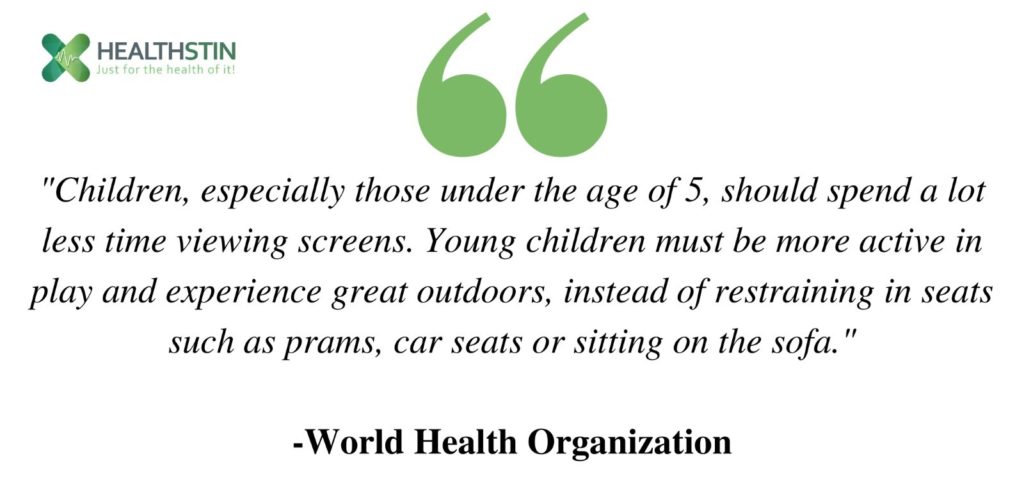
What are the possible effects of sedentary behavior on children?
Too much screen time equals less physical activity time.
According to Dr Daniel Pelzer, a pediatrician in The Iowa Clinic, a child with sedentary behaviour is more likely to develop obesity and health problems such as:
- High blood pressure
- High cholesterol
- Asthma and other breathing problems
- Joint issues
- Type 2 diabetes
Childhood obesity also sets the stage for chronic diseases later on, such as cancer and heart diseases.
How to reduce screen time for kids?
-
Set clear limits: Establish clear rules around screen time and communicate them to your child. For example, you might limit screen time to one hour per day, or ban screens during mealtimes and before bed.
-
Provide alternatives: Encourage your child to engage in other activities, such as reading, playing outside, or spending time with friends and family. Make these activities fun and engaging to compete with screens.
-
Model healthy behavior: Kids learn from their parents, so if you’re always on your phone or watching TV, they’re likely to follow suit. Make a conscious effort to limit your own screen time and model healthy behavior.
-
Create screen-free zones: Designate certain areas of your home, such as bedrooms or the dinner table, as screen-free zones. This will help reinforce the idea that screens should not be the center of attention at all times.
-
Use parental controls: Many devices have parental controls that allow you to set limits on screen time or block certain apps and websites. Use these tools to help enforce your rules and keep your child safe online.
-
Encourage physical activity: Physical activity can help reduce screen time by giving kids another way to expend their energy. Encourage your child to participate in sports or other physical activities they enjoy.
-
Be consistent: Finally, be consistent with your rules and expectations around screen time. This will help your child understand that these limits are not negotiable and are an important part of maintaining a healthy lifestyle.
What are the benefits of physical activity on children?
According to Dr Daniel Pelzer, the benefits of regular physical activity for children are:
- Better cardiorespiratory fitness
- Stronger bones and muscles
- Higher energy levels and an enhanced sense of emotional well-being
- Better weight control
- Lower risk for a variety of diseases

How much is a physical activity recommended?
The Australian Physical Activity and Sedentary Behaviour Guidelines differ depending on the age of children.
For children aged 2–4 who are not in school, the guidelines recommend:
- at least 180 minutes a day of physical activity, including energetic play
- no more than 60 minutes a day engaged in the screen-based activity.
For children aged 5–12 and 13–17, the guidelines recommend:
- at least 60 minutes a day of moderate to vigorous-intensity physical activity
- no more than 2 hours a day of screen-based activity for entertainment (television, seated electronic games and computer use).

3 practical steps on how to boost physical activity and reduce kid’s screen time
STEP #1.) Observe and assess your kid’s screen time vs. physical activity time
Below is an example of a weekly monitoring sheet where you can observe and evaluate your child’s activities holistically.
By jotting down the essential data, you can learn the activities your child is consuming per day and the specific time and duration of their mobility.
STEP #2.) Create a plan according to age, condition, needs, likes, lifestyle and activities of your child
In planning your child’s schedule and activity, it’s not necessary to jumpstart heavily with your plan. Start small and improve gradually until you and your child can adopt a healthier and more active lifestyle.
Here are some useful ideas that you can insert into your game plan:
- Ask the experts– You may seek help from your child’s pediatrician and Accredited Exercise Physiologist– they will help you understand the importance of physical activity and the effect of too much screen time. These professionals know the best and appropriate exercise and physical activities for your child according to their age, condition and needs.
- Make a rule– Decide a schedule and limitation on your child’s screen time. For example, your child can use TV, cellphones and video games for leisure time on Saturdays only from 10 am to 12nn.
- Be active during screen time – Your child can also be active while having screen time. You can watch together a video program for kids with dance steps or physical activities that your child can follow.
- Encourage your child to play with active toys – Toys like jump rope, ball, hula hoop, or other active toys can help distract from playing online games, watch movies or other activities that fall as sedentary.
- Encourage your child to play outside – Plan a schedule for a game or fun physical activity outdoor with the whole family. It can be a ball game, swimming, biking, hula hoop or tag game.
- Join a fitness program – Joining a program that focuses on fitness can benefit your child in enhancing their social strengths, exploring special abilities, and enhancing overall physical and mental health. A physical recreation program designed for kids run by Healthstin’s trained Accredited Exercise Physiologists. All abilities are welcome to join in GO! program, like children with Autism Spectrum Disorder (ASD), vision impairment, deaf or hard of hearing, mental health condition, intellectual disability and physical disability. GO! program is run by our trained Accredited Exercise Physiologists.
After you learned your kid’s daily activities through a weekly monitoring sheet and got professional advice from the pediatrician and Accredited Exercise Physiologist, decide the activity you need to lessen, increase, remove or add. At this stage, create an ideal daily schedule for your child’s activity from wake-up time until sleep time.
STEP #3.) Implementation
- Before you implement your plan, have a one-on-one talk with your child and convincingly explain your time management goal. By implementing your game plan, make sure that you will stick firmly to your schedule.
- Aside from physical and screen-based activity, we highly recommend to include optimal sleep in your child’s daily activities as well as the proper diet to ensure body and mind development.
- During the implementation stage, continuously fill-out your weekly monitoring sheet so you can still assess and compare the improvement that you and your child have made.
- Moreover, one of the essential factors is to become a role model for your child as a parent. Balancing screen time vs. physical activity is an issue for adults as well. You and your child can work together to balance physical activity and screen time to make a healthier lifestyle a habit. You can apply the steps not only for your little ones but also for your whole family.
CONCLUSION:
Digital technology is now a necessity for every Australian household. Gadgets with a screen such as television, mobile phone, tablet and laptop are platforms that we utilize for communication, education, entertainment and information. Part of good parenting is to control your kids’ screen time consumption and not compromise their health by using gadgets as pacifiers.
Leadership is the best skills that you should possess to manage your kid’s actions. Help your child become more disciplined and help them balance their physical activity time and screen time using the 3-step formula: assessment, planning, and implementation.
What do you think is the most useful tip you can apply for your kids? And, what’s your parenting style on balancing screen time and physical activity time? Please share them with us in the comment section below!

REFERENCES:
https://www.intellectualtakeout.org/article/how-phones-became-electronic-pacifiers/
https://www.abc.net.au/news/science/2020-09-05/screen-time-mental-health-kids-adolescents/12612454
https://www.iowaclinic.com/doctors/d35/daniel-pelzer/
https://www.aihw.gov.au/reports/children-youth/australias-children/contents/health/physical-activity
https://www.who.int/news/item/24-04-2019-to-grow-up-healthy-children-need-to-sit-less-and-play-more