Skip to content

We are looking for a Physiotherapist to join our team. Click here to apply

Free 10-Min Phone Consultation
[email protected]
1300 090 931
HealthStin logo with tagline.
a green rectangle with white text
a purple sign with white text
  • About Us
    • Why Choose Us
    • Our Team
    • Blog
    • News
    • Contact Us
    • FAQs
  • Services
    • Exercise Physiology
    • Hydrotherapy
    • Group Classes
    • Heal Program
    • Physiotherapy
    • Remedial Massage Therapy
    • Acupuncture
    • Insurances
    • NDIS
    • Home Care Packages
    • Commonwealth Home Support Program
    • Support at Home
    • Workers Compensation
    • Department of Veterans’ Affairs
    • Delivery Methods
    • In Clinic
    • Hydrotherapy Pool
    • Gym
    • Mobile
    • In-home Visits
    • Local Community Visits
    • Telehealth
  • Our Clinics
    • Sans Souci, NSW
      • Exercise Physiology at Healthstin Sans Souci
      • Hydrotherapy at Healthstin Sans Souci
      • Physiotherapy at Healthstin Sans Souci
    • Hurstville, NSW
      • Exercise Physiology at Healthstin Hurstville
      • Hydrotherapy at Healthstin Hurstville
      • Physiotherapy at Healthstin Hurstville
    • Brimbank, VIC
      • Exercise Physiology at Healthstin Brimbank
      • Hydrotherapy at Healthstin Brimbank
      • Physiotherapy at Healthstin Brimbank
    • Melton, VIC
      • Exercise Physiology at Healthstin Melton
      • Hydrotherapy at Healthstin Melton
      • Physiotherapy at Healthstin Melton
    • Elizabeth, SA
      • Exercise Physiology in Elizabeth
      • Hydrotherapy in Elizabeth
      • Physiotherapy in Elizabeth, SA
    • Salisbury, SA
      • Exercise Physiology in Salisbury
      • Hydrotherapy in Salisbury
      • Physiotherapy in Salisbury
    • Belmont, WA
      • Exercise Physiology in Belmont, WA
      • Hydrotherapy in Belmont
      • Physiotherapy in Belmont
  • Our Expertise
    • Health conditions we support include:
    • Stroke Rehab
    • Intellectual Disabilities
    • Autism Spectrum Disorder
    • Cerebral Palsy
    • Multiple Sclerosis
    • Anxiety & Depression
    • Obesity
    • Spinal Cord Injury
    • Down Syndrome
    • Arthritis
  • Careers
    • Explore Job Opportunities
    • Exercise Physiologists Careers
    • Physiotherapists Careers
    • New Graduate
    • Recruitment FAQs
  • Resources
    • Free e-book
    • Free NDIS Consultation
    • Free Aged Care Consultation
    • New Patient Form
    • Referral Form
    • HealthLink Referral
  • Free 10-Min Phone Consultation

a green rectangle with white text
a purple sign with white text

Popular Keywords

Categories

No Record Found

View More
HealthStin logo with tagline.
We are looking for a Physiotherapist to join our team. Click here to apply
[email protected]
1300 090 931
  • About Us
    • Why Choose Us
    • Our Team
    • Blog
    • News
    • Contact Us
    • FAQs
  • Services
    • Exercise Physiology
    • Hydrotherapy
    • Group Classes
    • Heal Program
    • Physiotherapy
    • Remedial Massage Therapy
    • Acupuncture
    • Insurances
    • NDIS
    • Home Care Packages
    • Commonwealth Home Support Program
    • Support at Home
    • Workers Compensation
    • Department of Veterans’ Affairs
    • Delivery Methods
    • In Clinic
    • Hydrotherapy Pool
    • Gym
    • Mobile
    • In-home Visits
    • Local Community Visits
    • Telehealth
  • Our Clinics
    • Sans Souci, NSW
      • Exercise Physiology at Healthstin Sans Souci
      • Hydrotherapy at Healthstin Sans Souci
      • Physiotherapy at Healthstin Sans Souci
    • Hurstville, NSW
      • Exercise Physiology at Healthstin Hurstville
      • Hydrotherapy at Healthstin Hurstville
      • Physiotherapy at Healthstin Hurstville
    • Brimbank, VIC
      • Exercise Physiology at Healthstin Brimbank
      • Hydrotherapy at Healthstin Brimbank
      • Physiotherapy at Healthstin Brimbank
    • Melton, VIC
      • Exercise Physiology at Healthstin Melton
      • Hydrotherapy at Healthstin Melton
      • Physiotherapy at Healthstin Melton
    • Elizabeth, SA
      • Exercise Physiology in Elizabeth
      • Hydrotherapy in Elizabeth
      • Physiotherapy in Elizabeth, SA
    • Salisbury, SA
      • Exercise Physiology in Salisbury
      • Hydrotherapy in Salisbury
      • Physiotherapy in Salisbury
    • Belmont, WA
      • Exercise Physiology in Belmont, WA
      • Hydrotherapy in Belmont
      • Physiotherapy in Belmont
  • Our Expertise
    • Health conditions we support include:
    • Stroke Rehab
    • Intellectual Disabilities
    • Autism Spectrum Disorder
    • Cerebral Palsy
    • Multiple Sclerosis
    • Anxiety & Depression
    • Obesity
    • Spinal Cord Injury
    • Down Syndrome
    • Arthritis
  • Careers
    • Explore Job Opportunities
    • Exercise Physiologists Careers
    • Physiotherapists Careers
    • New Graduate
    • Recruitment FAQs
  • Resources
    • Free e-book
    • Free NDIS Consultation
    • Free Aged Care Consultation
    • New Patient Form
    • Referral Form
    • HealthLink Referral
  • Free 10-Min Phone Consultation

a green rectangle with white text
a purple sign with white text
Popular Keywords
Categories

No Record Found

View More

7 Best Exercises for Stroke Patients (Safe & Effective Recovery Guide)

  • Published Date: Friday 08, May 2026
Last Update: Thursday 11, June 2026
Written by: Rachelle Sultana (PhD, Accredited Exercise Physiologist)
Author Profile Image

Rachelle Sultana (PhD, Accredited Exercise Physiologist)

Allied Health Coordinator

Dr. Rachelle leads the Allied Health Team at Healthstin Pty Ltd as Senior Exercise Physiologist and Allied Health Coordinator. She…

View Profile
  • Linkedin circle Logo
  • Email circle Logo
  • Call circle Logo
  • Link circle Logo

Summary

Simple movements can be harder to do after a stroke. Many people feel weaker and less independent. If you do not have the right rehabilitation exercises, recovery can take longer, and everyday tasks may become more challenging.

Doing the right exercises can help you safely rebuild strength and improve how you move. This guide covers some of the best exercises for stroke recovery, from range-of-motion to functional movements.

You will also see tips and advice on when to get professional help. With consistent practise and the right support, these exercises can help you move more easily and feel more confident each day.

Topics covered in this article:

Contents
1. Why Exercise Is Essential After A Stroke?
2. Safety Tips Before Starting Exercises
2.1. Consult a physiotherapist
2.2. Start slow
2.3. Use support when needed
2.4. Monitor fatigue
3. Best Exercises for Stroke Patients (Step-by-Step)
3.1. 1. Range of Motion Exercises (Beginner)
3.1.1. Assisted Arm Lifts
3.1.2. Seated Leg Extensions
3.2. 2. Seated Strength Exercises
3.2.1. Seated Marches
3.2.2. Seated Leg Lifts
3.2.3. Arm Strengthening
3.3. 3. Sit-to-Stand Practice
3.3.1. Need Help with Stroke Recovery?
3.4. 4. Balance and Coordination Exercises
3.4.1. Standing balance
3.4.2. Side-to-Side Weight Shifting
3.5. 5. Walking Practice
3.5.1. Step Training
3.5.2. Assisted walking
3.6. 6. Resistance Training (Progression)
3.6.1. Resistance Band Chest Press
3.6.2. Seated Shoulder Press
3.7. 7. Functional Movement Exercises
3.7.1. Seated Reaching
3.7.2. Seated Bending Practice
3.7.3. Daily tasks
4. Beginner to Advanced Exercise Progression
4.1. Early-stage exercises
4.2. Mid-stage strengthening
4.3. Advanced mobility training
5. Common Mistakes to Avoid
6. When to Seek Professional Help
7. How Healthstin Supports Stroke Rehabilitation
7.1. Personalised Exercise Programmes
7.2. Home and Clinic Visits
7.3. Physiotherapy and Exercise Physiology
7.4. Progress Tracking
8. FAQs About Best Exercises for Stroke Patients
8.1. 1. How often should stroke patients exercise?
8.2. 2. Can exercises be done at home?
8.3. 3. How long does recovery take?
8.4. 4. Are these exercises safe for elderly patients?
8.5. 5. Do I need supervision?
9. Start Your Recovery Journey with the Proper Support

Not sure what the right next step is for your situation?

We’ll help you understand which type of support fits your goals, needs, and circumstances.

Unsure which therapy or exercise programme is safe to start after a stroke?

We’ll help you understand which support options may help you move forward safely.

See What Support Fits

Clear advice. Zero commitment.

We’ll review your situation and tell you which service makes sense—and why.
Loading
Healthstin tailored best exercises for stroke patients

Post-stroke patients often need to learn movements again that once felt natural. Mobility issues can make daily tasks harder and affect confidence and independence.

The good news is that the right exercises can help you rebuild strength and coordination over time. With regular therapy and simple exercises at home, many people gradually improve and return to their daily activities.

Why Exercise Is Essential After A Stroke?

Exercise is a key part of recovery from a stroke. After a stroke, the brain and body need to learn how to work together again. Doing regular stroke rehabilitation exercises helps the brain adjust and form new pathways, a process called neuroplasticity. This means other parts of the brain can take over the affected tasks.

Physiotherapy exercises after a stroke can also help rebuild muscle strength, improve balance, and restore coordination. These exercises can make daily movements like standing up or reaching for things easier in the long run.

Moving regularly can also help prevent other health problems that may occur after a stroke. Exercise reduces stiffness, improves circulation, and keeps your joints flexible. Simple stroke recovery exercises at home can help you stay independent and support a smoother recovery.

Safety Tips Before Starting Exercises

Before you start any exercises after a stroke, it’s important to ensure they are safe for your condition and stage of recovery. Everyone’s stroke recovery is different, so getting the right advice can help you avoid injury and choose the best exercises for you.

Consult a physiotherapist

A qualified physiotherapist can help you find the right exercises for your recovery stage and your abilities.

Start slow

Focus more on slow and controlled movement rather than speed. Start with gentle movements and shorter sessions. Afterwards, gradually increase the difficulty as you become stronger and more coordinated.

Use support when needed

If you have trouble with balance or feel weak, use a sturdy chair, wall, or rail for support. This can help you stay safe and feel more confident whilst you exercise.

Monitor fatigue

It’s normal to feel a bit tired when you exercise, but doing too much can slow your recovery. Pay attention to how you feel and take breaks when you need to.

Best Exercises for Stroke Patients (Step-by-Step)

A strong recovery plan helps you rebuild movement one step at a time. The exercises below can improve your flexibility, strengthen your muscles, and help you balance and coordinate better. You can do many of these movements at home as part of your stroke therapy.

1. Range of Motion Exercises (Beginner)

These exercises are usually the first step in neurorehabilitation. These gentle movements for your arms and legs help keep your joints flexible and prevent stiffness as you get better.

Assisted Arm Lifts

Senior stroke patient performing assisted arm lift rehabilitation exercises while seated, improving upper body mobility, arm strength, and stroke recovery through guided physiotherapy movements at Healthstin.

  1. Sit up straight in a sturdy chair and let your arms rest at your sides.
  2. Bend the elbow of your affected arm so it forms a right angle (90 degrees).
  3. Slowly raise your arm in front of you until it is level with your shoulder.
  4. With your good hand, gently hold the wrist of your affected arm.
  5. Use your good hand to help lift your affected arm above your head until your elbow is straight.
  6. Slowly lower your arm back down to where you started.
  7. Repeat this movement slowly and with control.

Seated Leg Extensions
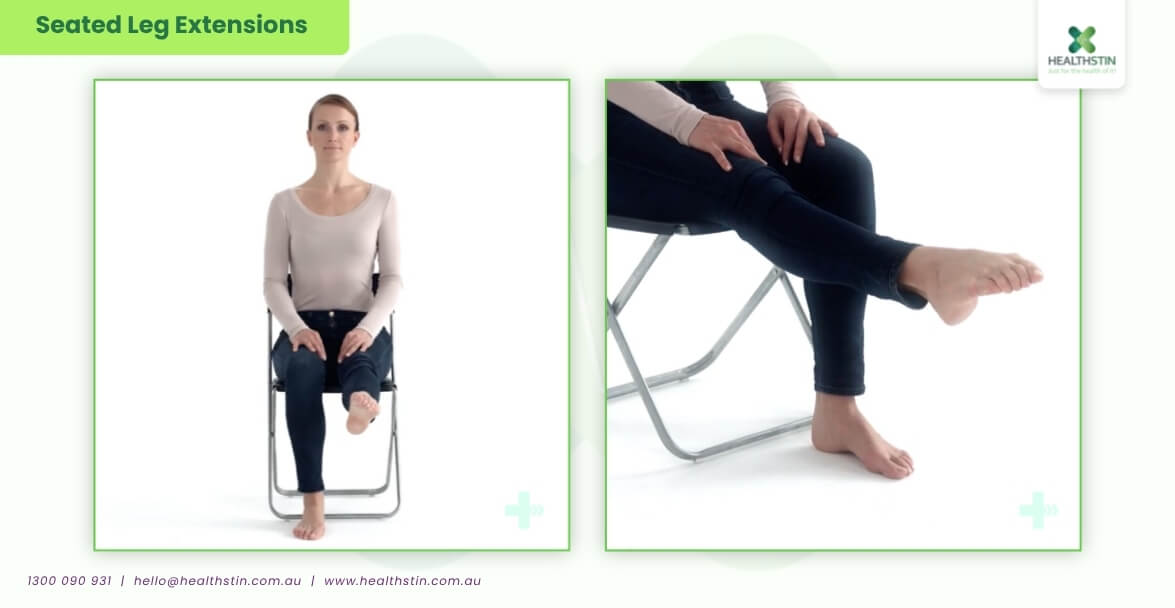
Stroke patient performing seated leg extension exercises to improve lower body strength, knee mobility, balance, and stroke rehabilitation recovery while seated on a chair at Healthstin.

  1. Sit up straight in a stable chair and place your feet flat on the floor.
  2. Relax your shoulders and keep your back straight.
  3. Slowly stretch your affected leg out in front of you.
  4. Try to straighten your knee as much as feels comfortable.
  5. Hold the stretch for a moment at the top.
  6. Slowly bring your foot back down to the starting position.
  7. Repeat this exercise as your therapist recommends.

These exercises keep your joints moving and get your body ready for more advanced exercises to regain mobility after a stroke.

2. Seated Strength Exercises

When moving becomes a bit easier, you can try seated exercises to safely rebuild muscle strength. These muscle-strengthening exercises work both your arms and legs whilst helping you stay stable.

Seated Marches
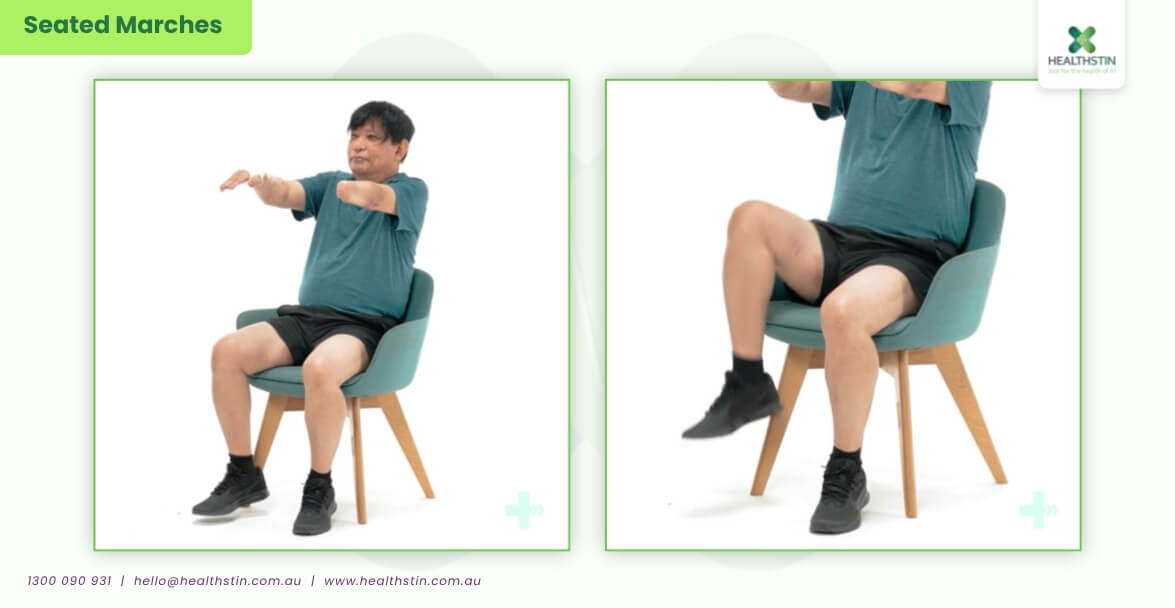
Stroke patient performing seated marching exercises to improve leg strength, coordination, circulation, and mobility during seated stroke rehabilitation therapy at Healthstin.

  1. Sit up straight in a stable chair with your feet flat on the floor.
  2. Keep your back straight and let your shoulders relax.
  3. Slowly lift one knee up, as if you are marching in place.
  4. Lower your foot back down to the floor with control.
  5. Repeat this movement with your other leg.
  6. Continue switching legs in a steady marching rhythm.

Seated Leg Lifts

Stroke patient performing seated leg lift exercises to strengthen lower limbs, improve balance, mobility, and coordination during stroke rehabilitation therapy at Healthstin.

  1. Sit upright on a sturdy chair with your feet flat on the floor.
  2. Keep your back straight and let your shoulders relax.
  3. Slowly lift one foot off the floor.
  4. Whilst the leg is lifted, straighten your knee to extend the leg forward.
  5. Gently bend the knee again and lower your foot back to the floor.
  6. Repeat the movement with the other leg.
  7. Continue switching legs at a slow, steady pace.

Arm Strengthening
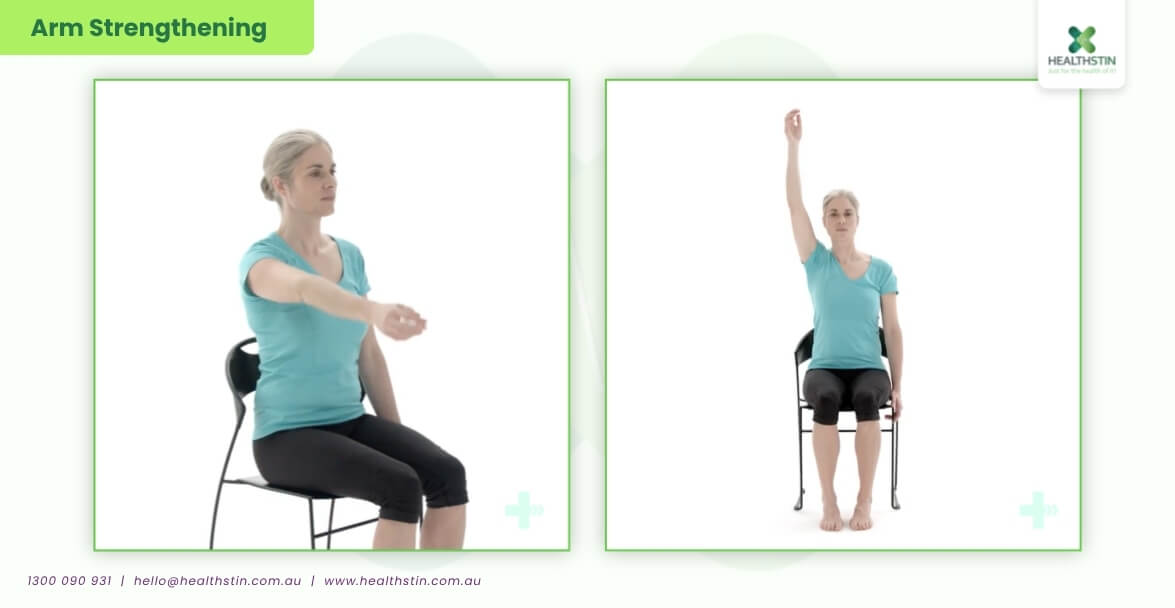
Stroke patient performing seated arm strengthening exercises to improve upper body mobility, shoulder movement, arm coordination, and muscle recovery during stroke rehabilitation therapy at Healthstin.

  1. Sit upright in a sturdy chair with your arms relaxed by your sides.
  2. Keep your back tall, and relax your shoulders.
  3. With your thumb pointing upward, slowly lift your weaker arm forward.
  4. Keep your elbow straight as you raise your arm.
  5. Lift the arm to a comfortable height.
  6. Hold the position briefly.
  7. Slowly lower the arm back down to your side with control.

These exercises help you build the strength you need for daily activities like walking or standing.

3. Sit-to-Stand Practice

The sit-to-stand movement is important for getting back your independence. This exercise helps strengthen your legs and prepares you for gait training and other activities.
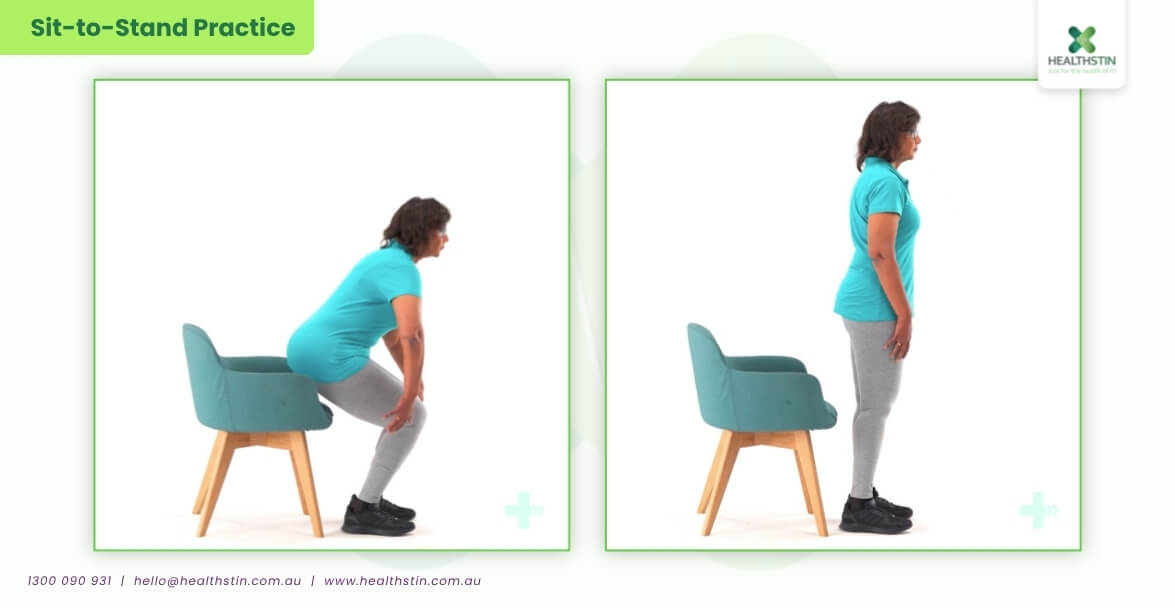
Stroke patient practicing sit-to-stand exercises from a chair to improve lower body strength, balance, mobility, and functional independence during stroke rehabilitation therapy at Healthstin.

  1. Sit up straight on a sturdy chair.
  2. Move your hips forward until you are near the edge of the seat.
  3. Place your hands on your thighs.
  4. Lean your upper body forward a little, letting your weight shift onto your feet.
  5. Push through your feet and stand up, straightening your hips and knees until you are standing tall.
  6. Pause for a moment whilst you stand tall.
  7. Put your hands on your thighs again and slowly sit back down in a controlled way.

Practising this movement often helps you build the strength and coordination you need for daily tasks, like getting up from a chair or moving around your home.

Need Help with Stroke Recovery?

If you or someone you care about is recovering from a stroke, having the right support can really help. At Healthstin, our physiotherapists and exercise physiologists work with you to create a personalised rehab plan that helps you regain strength and support long-term recovery.

Call 1300 090 931 to speak with our rehab team today. We’ll guide you through your options and help you move forward with your recovery.

4. Balance and Coordination Exercises

Once you have regained some basic strength, the next step is to work on stability. Balance and coordination training helps stroke survivors control their movements better and feel more confident when standing or walking. These exercises are often part of neurorehabilitation programmes and can also be done at home.

Standing balance
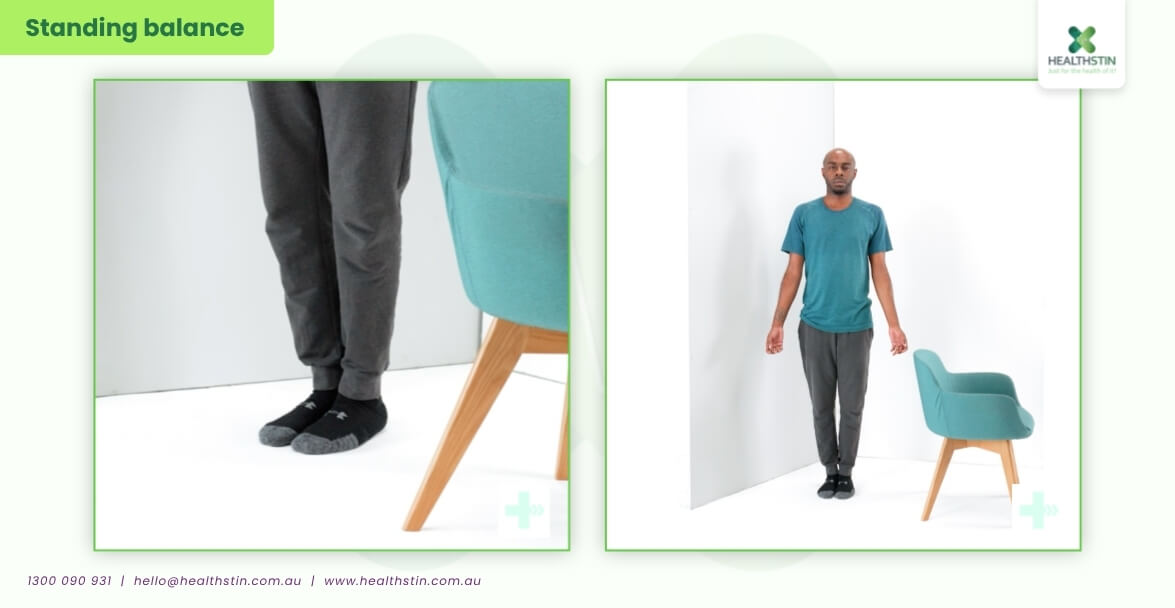
Stroke patient performing standing balance exercises beside a chair to improve stability, posture, coordination, and fall prevention during stroke rehabilitation therapy at Healthstin.

  1. Stand with your back close to a corner for safety, and keep a sturdy chair next to you for support.
  2. Put your feet together so they are touching or almost touching.
  3. Let your arms hang naturally at your sides.
  4. Try to keep your balance whilst standing up straight with your eyes open.
  5. Hold this position for a few seconds and keep your posture upright.
  6. If you feel unsteady, use the chair or wall for support.
  7. Repeat this exercise as your therapist recommends.

Side-to-Side Weight Shifting
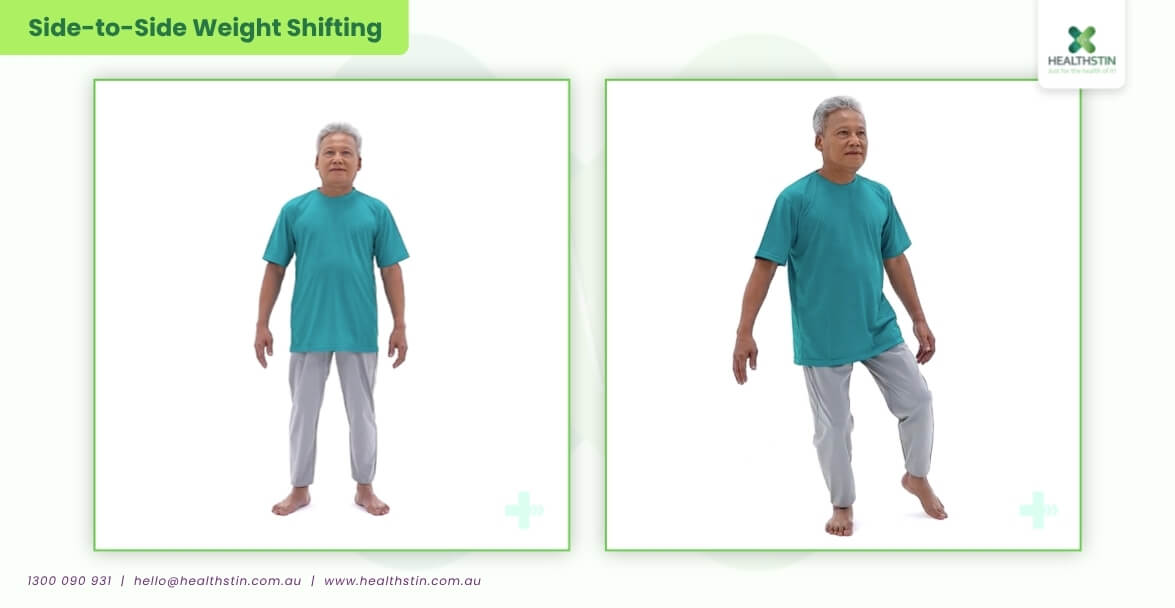
Stroke patient performing side-to-side weight shifting exercises to improve balance, coordination, stability, and lower body control during stroke rehabilitation therapy at Healthstin.

  1. Stand up straight with your feet about hip-width apart or a little wider.
  2. Let your arms relax at your sides.
  3. Make sure your weight is spread evenly between your heels and the balls of your feet.
  4. Slowly shift your weight to one leg and bend your knees a little.
  5. Let the toes of your other foot lightly touch the floor to help with balance.
  6. Gently shift your weight back to the center, then move it to the other side.
  7. Let your arms move naturally as you shift, reaching out a little to each side.

If you do these exercises regularly, you may find it easier to stand up and handle your daily activities.

5. Walking Practice

Learning to walk again after a stroke takes time and practise. Most patients start with small steps and gradually build up to longer ones. Practising walking helps you move more safely at home and in your community.

Step Training

Stroke patient performing step training exercises to improve walking ability, leg coordination, balance, and mobility during stroke rehabilitation therapy at Healthstin.

  1. Stand upright with a wall or any stable object beside you for support if needed.
  2. Keep your posture tall and your gaze looking forward.
  3. Step forward with one foot.
  4. Bring the other foot forward to meet it.
  5. Next, step backward with the same foot.
  6. Bring the other foot back to return to the starting position.
  7. Repeat the movement several times.
  8. Then switch sides and begin stepping with the other leg.

This exercise helps you get better coordination in your legs and feel more confident when you walk.

Assisted walking

Stroke patient performing assisted walking exercises with a walking aid to improve gait, balance, coordination, and mobility during stroke rehabilitation therapy at Healthstin.

  1. Stand upright whilst holding your walking stick in one hand.
  2. If one leg is weaker, hold the stick in the opposite hand.
  3. Move the walking stick slightly forward.
  4. Step forward with your weaker leg so it comes level with the stick.
  5. Next, step forward with your stronger leg, moving it past the weaker leg and the stick.
  6. Place the stronger foot on the ground ahead.
  7. Continue walking in this order, going at a pace that feels steady and comfortable for you.

Practising walking regularly can help you move more easily and make daily activities at home easier.

6. Resistance Training (Progression)

Try adding gentle resistance to help build strength as you become more comfortable with movement. Light weights or resistance bands make your muscles work a little harder in a safe way. These exercises can help with daily tasks and improve your movement.

Resistance Band Chest Press
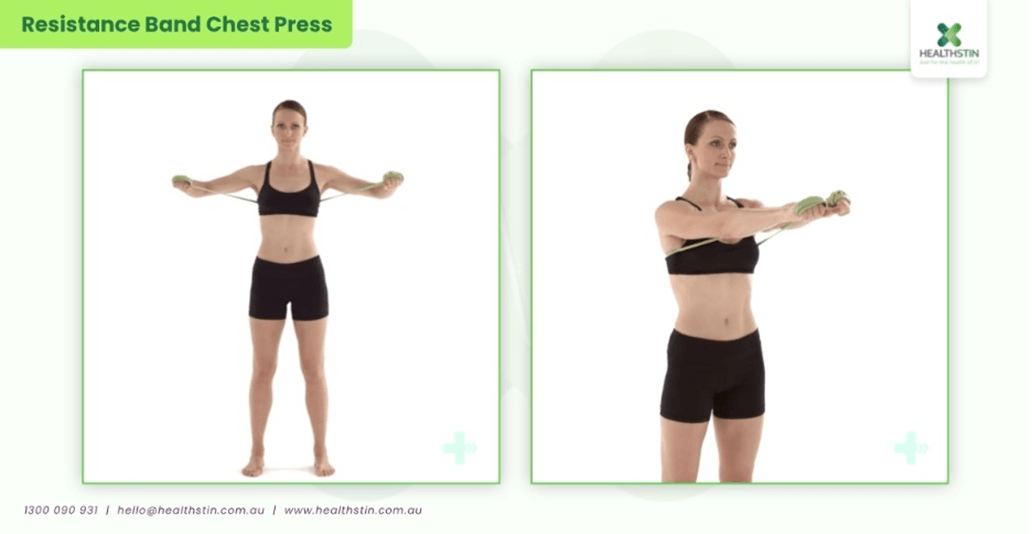
Woman performing resistance band chest press exercises to strengthen upper body muscles, improve posture, shoulder stability, and functional movement during physiotherapy rehabilitation at Healthstin.

  1. Sit or stand up straight, keeping your back tall.
  2. Loop a resistance band behind your back and under your arms.
  3. Hold one end of the band in each hand.
  4. Begin with your elbows bent and your hands close to your chest, keeping a little tension in the band.
  5. Slowly push your arms forward until they are straight out in front of you.
  6. Pause for a moment at the end.
  7. Slowly bend your elbows and bring your hands back to the starting position with control.
  8. Repeat this movement as your therapist or guide suggests.

Seated Shoulder Press
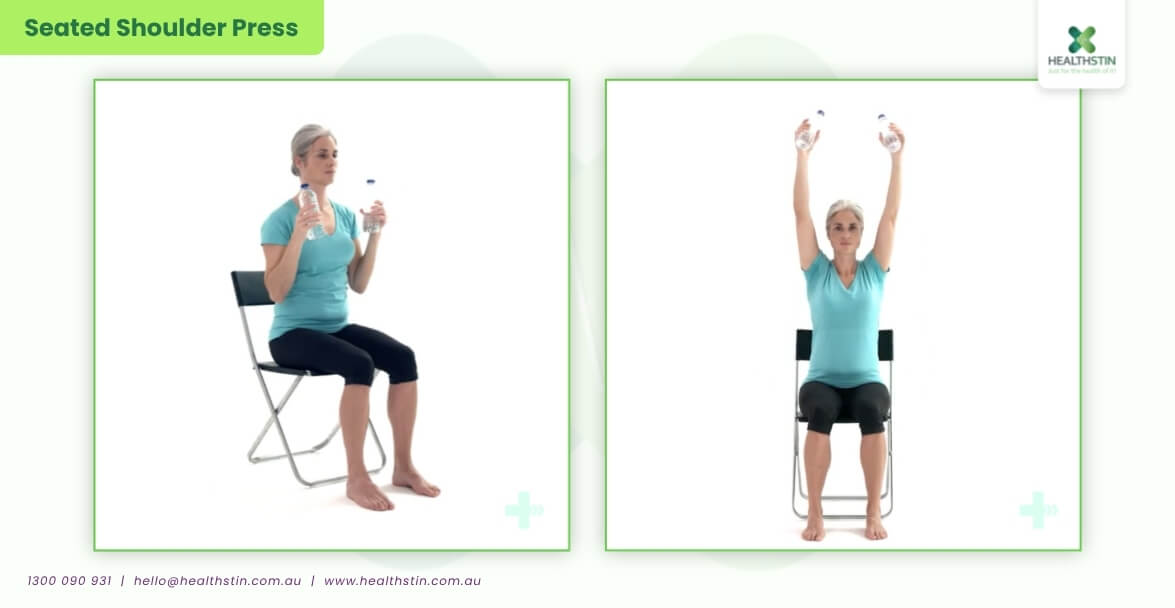
Woman performing seated shoulder press exercises with light weights to improve shoulder strength, upper body mobility, posture, and rehabilitation recovery while seated at Healthstin.

  1. Sit up straight in a sturdy chair, lifting your chest and gently pulling your shoulders back.
  2. Hold a light weight or water bottle in each hand, or just one hand if that works better for you.
  3. Let your arms relax at your sides to start.
  4. Bend your elbows and lift the weights up to shoulder height.
  5. Slowly press the weights up until your arms are straight above your head.
  6. Pause for a moment at the top.
  7. Slowly lower the weights back down to shoulder height with control.
  8. Repeat as your therapist or guide suggests.
  9. If needed, you can do the movement with one arm at a time.

Gradually adding resistance can make post-stroke leg and arm exercises more effective, whilst still keeping them safe for your daily routine.

7. Functional Movement Exercises

Try exercises that use movements you do every day at this stage of your recovery. Practising these can help you become more independent and move more easily in daily life.

Seated Reaching

Stroke patient performing seated reaching exercises to improve balance, arm coordination, flexibility, and functional movement during stroke rehabilitation therapy at Healthstin.

  1. Sit upright on a sturdy chair without armrests.
  2. Place your feet flat on the floor and sit up straight.
  3. Slowly reach one hand down to the side, as if you are picking something up from the floor.
  4. Reach only as far as you feel comfortable and safe.
  5. Return to the starting position and sit up straight to regain your balance.
  6. Pause for a moment, then repeat the movement on your other side.
  7. Keep switching sides as you repeat the exercise.

Seated Bending Practice

Stroke patient performing seated bending practice exercises to improve flexibility, balance, coordination, and functional movement during stroke rehabilitation therapy at Healthstin.

  1. Sit up straight on a stable chair and keep your feet flat on the floor.
  2. Place a small object on the floor in front of you.
  3. Lean forward and slowly bend down to pick up the object.
  4. Sit back up straight.
  5. Relax your shoulders and pause for a moment before putting the object back on the floor.
  6. Repeat this movement at a pace that feels comfortable for you.
  7. As you gain confidence and control, slowly increase how many times you do the exercise.

Daily tasks

Try simple activities, like opening doors or moving household items. These movements can help you feel confident and support your independence during stroke therapy at home.

Beginner to Advanced Exercise Progression

Recovery from a stroke is a slow process. Each step builds on the one before. The body can safely adjust by slowly adding new exercises. These exercises can help survivors become more independent and move more easily.

Early-stage exercises

Early exercises focus on bringing back basic movement and coordination. These simple and supported activities are safe for building confidence.

Mid-stage strengthening

After basic movement gets easier, the focus shifts to building strength and stability. This stage often adds more standing and controlled exercises to get the body ready for daily tasks.

Advanced mobility training

Exercises at this stage involve more complex movements that mirror daily activities. These help stroke survivors move more confidently at home and in their community.
Healthstin Blog Important Safety Medical Disclaimer Banner 1

Common Mistakes to Avoid

Exercise plays a key role in stroke recovery. If you do exercises the wrong way, it can slow your progress or even lead to injury.

Learning about common mistakes can help you stay safe and improve your movement over time.

  • Overexertion: Pushing yourself too fast can cause soreness, tiredness, or even setbacks.
  • Incorrect technique: Using poor form can make exercises less helpful and raise your risk of strain.
  • Skipping sessions: Sticking to a regular exercise routine helps you make steady progress.

When to Seek Professional Help

There are times when doing stroke recovery exercises at home is not enough. If you notice any of the signs below, consider talking to a physiotherapist or rehabilitation professional.

  1. Severe weakness – You have trouble lifting or moving your arm or leg despite regular practise.
  2. Balance issues – You often lose your balance or feel unsteady when standing or walking.
  3. Pain or discomfort – You feel sharp pain or unusual discomfort during exercise.
  4. Lack of progress – Your recovery seems to have stopped, even though you keep up with your exercises at home.

How Healthstin Supports Stroke Rehabilitation

Recovering from a stroke is easier with the right support and a clear plan. At Healthstin, our team helps people at every stage of stroke rehabilitation by offering personalised care and practical therapy programmes.

Personalised Exercise Programmes

Our clinicians design stroke rehabilitation exercises that match your current abilities and stage of recovery. These can include exercises to help you regain mobility, strengthen your arms and legs, and improve your balance and coordination.

Home and Clinic Visits

Healthstin offers flexible treatment options, such as clinic appointments and home visits. With home-based stroke therapy, you can practise movements and exercises as part of your daily routine.

Physiotherapy and Exercise Physiology

At Healthstin, we use both physiotherapy exercises and exercise physiology. This combined approach supports neurorehabilitation and helps you move safely from basic movements to more advanced activities, such as gait training.

Progress Tracking

Recovery takes time. Our clinicians track your progress in mobility, coordination, and strength to ensure your exercise programme continues to progress safely.

Our rehabilitation team is here to support you at every stage. Get in touch with us to find out how we can help you begin or continue your recovery.

FAQs About Best Exercises for Stroke Patients

1. How often should stroke patients exercise?

Most people are advised to do stroke rehab exercises a few times each week. Short, regular sessions often work better than long workouts. A physiotherapist or exercise professional can help you find the best schedule for your stage of recovery.

2. Can exercises be done at home?

Yes. Many stroke exercises are simple and practical, so you can do them at home. A therapist can demonstrate the movements and provide a plan for you to follow at home.

3. How long does recovery take?

There is no set timeline for stroke recovery. Some people get better quickly, whilst others improve more slowly. Regular exercise and rehab support can help.

4. Are these exercises safe for elderly patients?

In most cases, yes. Exercises are usually matched to each person’s strength, balance, and mobility. Gentle movements and having someone supervise can help keep things safe and effective.

5. Do I need supervision?

Having someone supervise can be helpful, especially early in recovery. A physiotherapist or exercise professional can guide you and adjust your exercises as you get stronger.

Start Your Recovery Journey with the Proper Support

Getting started early with rehab and sticking to a clear exercise plan can lead to better results after a stroke. With professional help, stroke recovery exercises can boost your mobility and make your daily tasks easier as you progress.

At Healthstin, our experienced physiotherapists and exercise professionals create personalised stroke rehab programmes just for you. We focus on safe, practical exercises that help you move better every day and keep making progress over time.

You can choose therapy at home or in our clinic, and we’ll be here to support your recovery every step of the way.

Book a physiotherapy assessment with Healthstin today and talk to our team about the best rehab plan for you.

*Disclaimer: The exercises and information in this article are meant as general guidance only and do not replace advice from a qualified healthcare professional. Stroke rehab programmes should always be personalised. Before starting any new exercises, talk to a physiotherapist, exercise physiologist, or your healthcare provider to make sure they are safe and right for you.
More Articles

Physiotherapist and participant reviewing an NDIS plan letter together at a clinic desk
Friday 02, October 2026

Understanding NDIS Pricing Changes in 2026-27: A...

Healthstin provides NDIS Services in Midland
Thursday 01, October 2026

NDIS Services in Midland: Comparing NDIS-Funded Therapies...

Healthstin provides Accredited Exercise Physiologist in Perth
Thursday 01, October 2026

Why Choose Accredited Exercise Physiologists (AEPs) in...

Healthstin NDIS Providers in Elizabeth SA – Providing complete guide to finding the right support
Thursday 01, October 2026

A Comprehensive Guide to NDIS-Approved Providers for...

Therapeutic Services in Sydney
Friday 18, September 2026

The Benefits of Therapeutic Services in Sydney:...

Category

  • Exercise Physiology 47
  • Physiotherapy 75
People exercising in a swimming pool

Not sure what the right next step is for your situation?

We’ll help you understand which type of support fits your goals, needs, and circumstances.

Unsure which therapy or exercise programme is safe to start after a stroke?

We’ll help you understand which support options may help you move forward safely.

See What Support Fits

Clear advice. Zero commitment.

We’ll review your situation and tell you which service makes sense—and why.

Loading

Find Professional Exercise Physiology and Physiotherapy Near You

Google map interface with options
Map showing Healthstin Allied Health location

Healthstin Sans Souci Clinic

Sans Souci, NSW

Google Maps interface with options
Map showing Healthstin Hurstville location

Healthstin Hurstville Clinic

Hurtsville, NSW

Google map interface with location details
Map showing Healthstin Brimbank location

Healthstin Brimbank Clinic

Keilor Downs, VIC

Google map interface with options
Map showing Healthstin Melton location

Healthstin Melton Clinic

Melton, VIC

Google Maps interface with location details
Map showing Healthstin Elizabeth location.

Healthstin Elizabeth Clinic

Elizabeth, SA

Google map interface with options
Map showing Healthstin Allied Health location

Healthstin Salisbury Clinic

Salisbury, SA

Map with Google logo overlay
Map showing Healthstin Belmont location

Healthstin Belmont Clinic

Belmont, WA

Map of Australia with states outlined

Coverage Areas for Home Visits

Type in your post code in the search bar and find out if we service your area.
RESULT:
Facebook-f Youtube Linkedin
Call Us

1300 090 931

Email Us

[email protected]

Healthstin Logo for footer

Our mission at Healthstin is to empower your abilities. We remove the barriers so you can take control of your health, maximise results and achieve optimal physical and mental well-being.

Book An Appointment
Quick Links
  • Home
  • About Us
  • Our Team
  • Contact Us
  • Blog
  • Clinics
  • FAQs
Our Clinics
  • Sans Souci
  • Hurstville
  • Brimbank
  • Melton
  • Elizabeth
  • Salisbury
  • Belmont
Services
  • Exercise Physiology
  • Hydrotherapy
  • Group Classes
  • Heal Program
  • Physiotherapy
  • Remedial Massage Therapy
  • Acupuncture
  • Insurances
  • NDIS
  • Home Care Packages
  • Commonwealth Home Support Programme
  • Workers’ Compensation
  • Support at Home
  • Department of Veterans' Affairs
  • Delivery Methods
  • In Clinic
  • Hydrotherapy Pool
  • Gym
  • Mobile
  • In-home Visits
  • Local Community Visits
  • Telehealth
Clinic Hours
New South Wales & Victoria
  • Monday-Friday 08:00AM - 6:00PM
  • Saturday 10AM - 3 00PM by appointment only
  • Sunday Closed
South Australia & Western Australia
  • Monday-Friday 08:00AM - 6:00PM
  • Saturday-Sunday Closed
Office Hours
New South Wales, Victoria, South Australia & Western Australia
  • Monday-Friday 09:00AM - 6:00PM
  • Saturday-Sunday Closed
@ Copyright 2026 Healthstin PTY LTD
  • Terms and Conditions
  • Privacy Policy
a white arrow in a green circle
Free 10-Min Phone Consultation
Accessibility Adjustments

Powered by OneTap

How long do you want to hide the toolbar?
Hide Toolbar Duration
Select your accessibility profile
Vision Impaired Mode
Enhances website's visuals
Seizure Safe Profile
Clear flashes & reduces color
ADHD Friendly Mode
Focused browsing, distraction-free
Blindness Mode
Reduces distractions, improves focus
Epilepsy Safe Mode
Dims colors and stops blinking
Content Modules
Font Size

Default

Line Height

Default

Color Modules
Orientation Modules
We use cookies on our website to give you the most relevant experience by remembering your preferences and repeat visits. By clicking “Accept”, you consent to the use of ALL the cookies.
Do not sell my personal information.
Cookie SettingsAccept
Manage consent

Privacy Overview

This website uses cookies to improve your experience while you navigate through the website. Out of these, the cookies that are categorized as necessary are stored on your browser as they are essential for the working of basic functionalities of the website. We also use third-party cookies that help us analyze and understand how you use this website. These cookies will be stored in your browser only with your consent. You also have the option to opt-out of these cookies. But opting out of some of these cookies may affect your browsing experience.
SAVE & ACCEPT
People exercising in a swimming pool

Not sure what the right next step is for your situation?

We’ll help you understand which type of support fits your goals, needs, and circumstances.

Unsure which therapy or exercise programme is safe to start after a stroke?

We’ll help you understand which support options may help you move forward safely.

See What Support Fits

Clear advice. Zero commitment.

We’ll review your situation and tell you which service makes sense—and why.

Loading

Real Experts. Real Results.

Not sure if you need Physio, Exercise Physiology or Hydro? We’ll tell you exactly what will work best—for free.

  • Get a customised care plan with just a single call
  • No referrals needed
  • Covered by NDIS, Aged Care, DVA, and Workcover or Private Health

Whether you’re dealing with pain, mobility issues, falls, or recovery, let us take the guesswork out. One of our experts will match you with the right service — at the right location and with the right funding — in under 10 minutes.

Loading
Healthstin Team members in a black suit
Quick Apply Form

Drag & Drop Files, Choose Files to Upload You can upload up to 100 files.
Loading

