Entering your forties brings subtle shifts in how your body moves and responds to physical activity. Maintaining lower-body strength becomes more challenging during this life stage due to natural physiological transitions. Natural age-related changes can lead to muscle loss, joint stiffness, and reduced mobility, making everyday activities harder—and increasing the risk of injury.
The good news is that you do not have to accept this as an unavoidable part of getting older. The right lower-body exercises can help build strength, support balance, and promote long-term health. Discovering the best lower body exercises for women over 40 can support your movement habits and restore your baseline physical confidence.
Why Lower Body Strength Matters After 40
Your legs, hips, and glutes form the structural foundation of every single movement you make throughout the day. As the female body encounters Hormonal changes and fitness variations during the perimenopause and menopause transitions, maintaining this foundation becomes paramount for long-term well-being.
Supports mobility and functional capacity: Building lean muscle tissue in your glutes, quadriceps, and hamstrings helps you maintain your physical mobility and self-reliance over time.
Supports balance and reduces fall risk: A strong lower base provides the framework for solid Balance and stability. This foundation acts as a safety system against unexpected trips, slips, or missteps on uneven footpaths.
Enhances bone density: Resistance training places healthy, mechanical stress on your skeletal system. This stimulus encourages your bones to retain vital minerals, which directly supports Bone density and protects against conditions like osteopenia and osteoporosis.
Supports metabolism: By preserving and building your Muscle strength, you keep your resting metabolic rate functioning optimally, which helps manage the natural body composition shifts that often occur after forty.
Safety Tips Before You Start
To achieve proper Injury prevention, keep these core principles in mind before beginning any lower-body strength session:
- Warm-up importance: Spend 5 to 10 minutes performing gentle movements, such as leg swings and a light walk, to increase blood circulation to your joints.
- Take it easy on your joints: Skip the jumping exercises for now. Instead, focus on smooth, slow, and steady movements that are gentle on your knees, hips, and ankles.
- Prioritise good form: Doing an exercise correctly is what keeps you safe from injury. It is much better to do five perfect repetitions than fifteen messy ones with bad posture.
- Listen to your body: If an exercise causes joint pain, stop immediately and modify the movement.
Best Lower Body Exercises for Women Over 40
When implementing a regular physical routine, the goal is to select movements that carry over directly into real-life tasks. Here is a selection of the best lower body exercises for women over 40 that focus on safety, joint longevity, and practical capability.
1. Squats (Modified if Needed)
Squats are a classic example of Functional fitness. They mimic the exact action of sitting down into a chair and standing back up, targeting your quadriceps, hamstrings, and core muscles.
How to do it: Stand with your feet about hip-width apart. Push your hips back and lower yourself down as if you are sitting in a chair. Keep your chest up and make sure your knees point in the same direction as your toes. Press firmly down through your heels to stand back up.
An easier option: Place a sturdy kitchen chair right behind you. Lower yourself down until your bottom lightly touches the seat, then stand back up. This takes the pressure off your knees and hips while still building great strength.
2. Lunges (or Supported Lunges)
Why it helps: Lunges work one leg at a time. This is excellent for balancing things out if one leg is a bit stronger than the other.
How to do it: Take a slow, steady step backward. Lower your back knee toward the floor until both legs are bent comfortably. Keep your body upright, then push off the floor to step back to where you started.
An easier option: Hold onto a wall or a sturdy kitchen bench with one hand to help you stay steady. Stepping backward while holding onto something makes the movement much friendlier on your knees.
3. Glute Bridges
The glute bridge is an exceptional low-impact movement that strengthens your hips and lower back without compressing your knees or ankles.
How to perform: Lie flat on your back with your knees bent and your feet flat on the floor. Squeeze your buttocks tightly and lift your hips until your body forms a straight line from your shoulders to your knees. Hold for 2 seconds before slowly lowering.
Build Strength for Life
Book Your Exercise Physiology Consultation with Healthstin
4. Step-Ups
Why it helps: Step-ups build real-world leg strength that makes it much easier to walk up hills, step over obstacles, or tackle a steep flight of stairs.
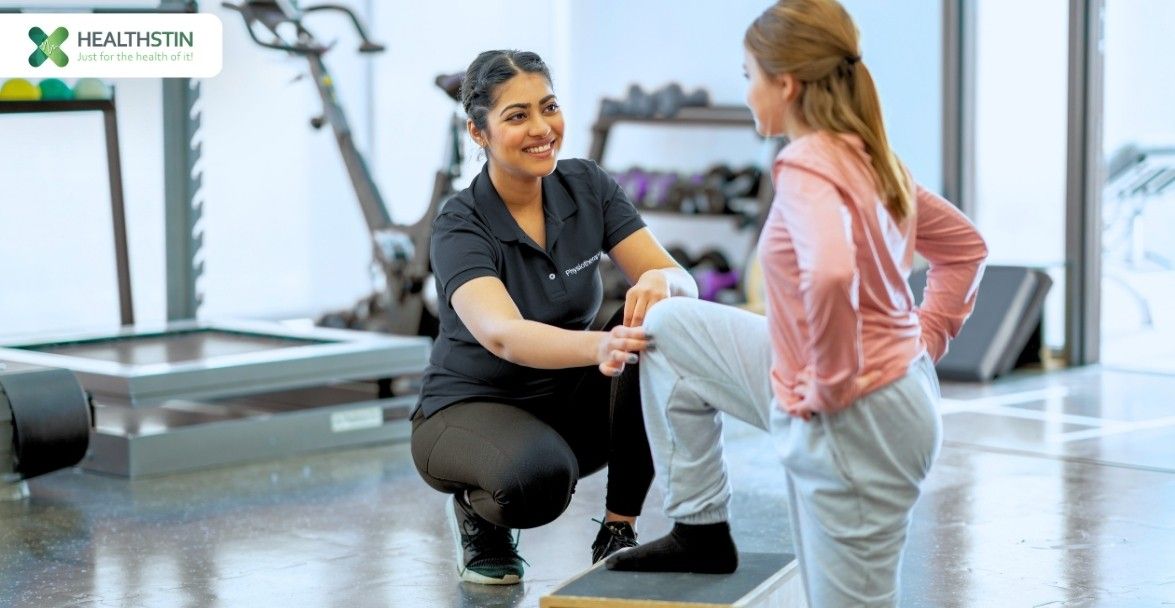
How to do it: Put your whole left foot flat on a low, sturdy step or the bottom step of your stairs. Push down through your heel to lift yourself all the way up. Then, slowly and carefully lower yourself back down until your right foot touches the floor.
5. Seated Leg Extensions
Why it helps: This exercise focuses straight on the muscles at the front of your thigh. It helps build up strength right around your knee without putting any heavy weight or pressure on your back.
How to do it: Sit up nice and tall in a sturdy chair. Slowly straighten your right knee until your leg is out straight in front of you. Give your thigh muscle a firm squeeze, hold it for a moment, and then slowly lower your foot back down.
6. Calf Raises
Calf raises support your lower leg resilience, making your ankles more stable on uneven terrain.
How to perform: Stand tall near a wall for balance support. Slowly lift your heels off the ground until you are standing high on the balls of your feet, then gently control the descent.
7. Resistance Band Leg Exercises
Why it helps: Elastic bands give you smooth, steady resistance that is incredibly kind to your bones and joints.
How to do it: Place a loop resistance band around your thighs, just above your knees. Take slow, careful steps sideways across the room, keeping a slight bend in your knees the whole time.
How to Structure Your Weekly Routine
To see lasting structural changes in your muscles and bones, your body requires a predictable, progressive stimulus:
| Phase | Recommendation | Focus Area |
| Frequency | 2 to 3 sessions per week | Muscle recovery and tissue repair |
| Volume | 2 to 3 sets of 8 to 12 reps | Controlled pace with proper alignment |
| Progression | Gradual increase in resistance | Small steps to avoid physical overload |
Always leave at least 48 hours of rest between your lower-body workouts. This gives your muscles plenty of time to rest, repair, and grow stronger.
How Healthstin Can Support Your Fitness Journey
At Healthstin, we know that every woman’s body moves differently, especially as we go through physical and lifestyle changes as the years pass. Our focus is simply on giving you safe, proven, and realistic health plans that fit your body perfectly through:
Personalised exercise frameworks: We thoroughly assess your current mobility, existing strength levels, and medical history to build a custom roadmap.
Injury prevention: By closely evaluating your movement mechanics, we address minor muscle imbalances before they turn into nagging daily concerns.
Clinical guidance: Working with our allied health team gives you access to physical education that supports you to exercise with total confidence.
Frequently Asked Questions
Are these exercises safe for beginners?
Yes. Every single exercise in this guide can be changed to fit a complete beginner. Starting with simple bodyweight movements or using a chair for support lets you build up your basic strength safely and comfortably.
Can I do these at home?
You certainly can. The majority of these movements require nothing more than a sturdy household chair, a clear wall space, and a set of affordable resistance bands. You do not need a commercial gym membership to achieve positive long-term health outcomes.
How often should I train?
For positive health and structural outcomes, targeting the lower body muscles 2 to 3 times per week is an appropriate baseline. This frequency provides the balance between stimulating your tissues and allowing proper systemic recovery.
What if I have knee discomfort?
Knee pain is very common, but it does not mean you have to stop moving altogether. You can easily switch to exercises where you do not have to stand and support your full body weight. Movements like seated leg extensions, floor glute bridges, or exercising in a pool are recommended to build up the muscles around your knees without rubbing or irritating the joint.
How long before I see results?
You will start noticing the brain-to-muscle connection kicking in within the first 2 to 3 weeks. This means you will feel more stable on your feet, notice improved coordination, and simply feel less tired during the day. Actual changes in your stamina, muscle tone, and how easy it feels to move around usually show up after 6 to 8 weeks of regular practice.
DISCLAIMER : The information and exercises provided in this article are for educational and informational purposes only and do not constitute professional medical advice, diagnosis, or treatment.
Knee problems are highly individual. Always seek the advice of your physician, physiotherapist, or other qualified health provider before starting any new exercise routine or making changes to your rehabilitation plan. If you experience pain, dizziness, shortness of breath, or increased discomfort while performing these exercises, stop immediately and consult a healthcare professional. Healthstin assumes no liability for injuries sustained while practicing these movements without professional supervision.
Healthstin provides exercise programs for women over 40 looking for water therapy across multiple states in Australia.
- Sans Souci, NSW – Supporting southern Sydney residents
- Hurstville, New South Wales (NSW) – Conveniently located for serving the St George community
- Salisbury & Elizabeth, South Australia (SA) – Accessible for Adelaide’s northern suburbs
- Brimbank & Melton, Victoria (VIC) – Supporting communities in Melbourne’s west
- Belmont, Western Australia (WA) – Expanding to meet growing local demand
Our team can deliver therapy in our clinics or within the community.
Know Someone Who Could Benefit Our Services?
Help someone take the first step. If you know a friend, a former subbie, or a loved one who is struggling to stay active or feeling socially isolated, we make the referral process simple. Whether they need physiotherapy for cerebral palsy, we’ll help them navigate the D904 or NDIS requirements with ease.
Refer Someone Today and help them start their path to better health and independence.