Getting older at home sounds simple enough, until a shoulder gets too stiff to reach the top cupboard, or a knee makes the front steps feel like a hazard. Many older Australians want nothing more than to keep living independently in the house they know, but mobility, balance, strength, or a chronic health condition can quietly get in the way of that.
If you ignore small daily struggles, they add up. A slip on the bathroom rug turns into a serious fall. Skipping a walk leads to weeks of lost strength. Over time, the chance of ending up in the hospital goes up, while the confidence to live on your own goes down.
That is where Home care therapies come in. Instead of travelling to a clinic, professionals like physiotherapists and exercise scientists come right to your door. They build a plan based on your everyday routine and the layout of your own home. This guide explains the options available in South Australia, how the Support at Home program helps pay for them, and what to look for when choosing a provider.
What Are Home Care Therapies?
What are home care therapies? They are allied health services, physiotherapy, exercise physiology, occupational therapy, dietetics, and hydrotherapy, delivered in a person’s own home rather than in a hospital or clinic waiting room.
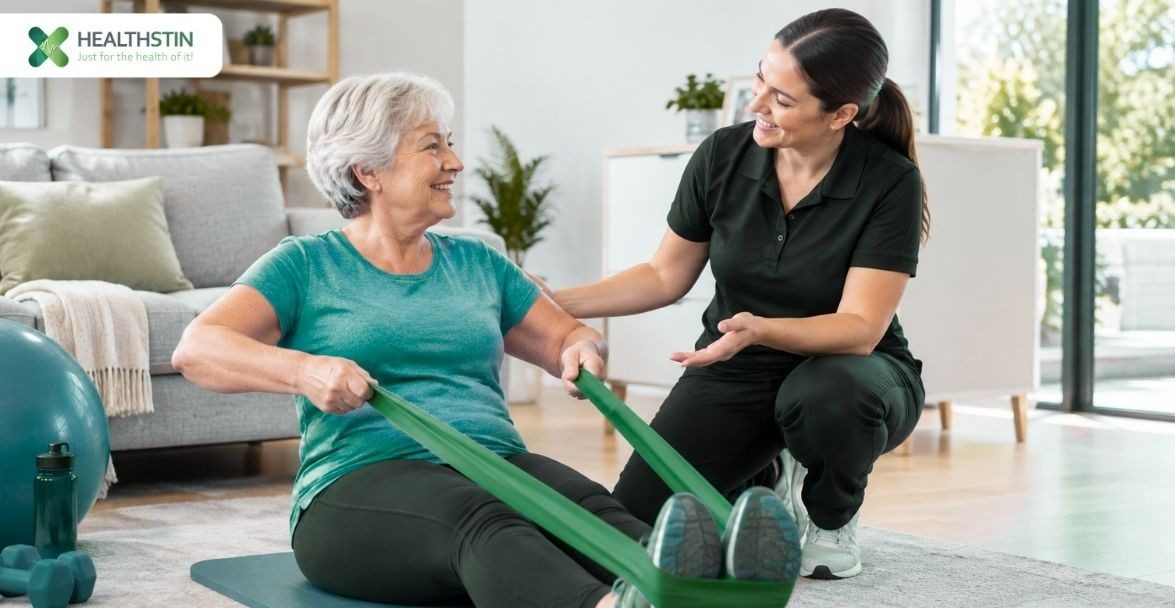
Home care allied health services distinguish between clinic and home sessions. Someone might walk well on a smooth clinic floor but struggle with their uneven back steps at home. In-home therapy lets a professional see your actual living space—like the rug that catches your foot, a high shower step, or a hard-to-reach kitchen counter.
Under both Home Care Packages and the newer Support at Home program, several allied health disciplines can provide mobility support and be funded to help someone live well at home, sitting within the same category as nursing and personal care rather than as an optional extra. For many older Australians, therapy delivered at home is one of the main reasons a package works at all.
The benefit of a familiar environment goes beyond convenience. People tend to try harder, and stick with a programme for longer, when the exercises are the ones they’ll actually use going up their own stairs, not a generic set done on a clinic mat.
Why Home-Based Therapy Is Important for Older Australians
Home-based therapy earns its keep in a handful of specific ways.
Supports Independence
In-home therapy focuses on the daily tasks that keep you independent, like getting off the couch, showering safely, or walking out to check the mail. Practicing the exact task in your own home helps you build the skills you need to keep doing them on your own.
Reduces Fall Risk
Roughly one in four Australians aged 65 and over has at least one fall a year, and falls are the leading cause of injury-related hospital admissions in this age group (Aged Care Quality and Safety Commission, citing AIHW data). A physiotherapist or exercise physiologist working in the home can spot fall hazards and build strength and balance at the same time, which is a big part of falls prevention.
Improves Mobility and Strength
Doing short, regular exercises right where you live helps build the strength and confidence you need to move around easily—whether that means standing up from a low chair or going up and down a flight of stairs.
Helps Manage Chronic Conditions
Managing health issues like arthritis, diabetes, or heart disease gets easier with steady, well-paced activity. When a therapist comes to your house, they can adjust your routine based on how you are feeling that week, rather than just following a plan on paper.
Promotes Healthy Ageing
Healthy ageing is not about avoiding every health issue. It is about staying as capable and connected as possible for as long as possible, and home-based allied health support is one of the more practical tools for doing that.
Home Care Therapies Available in South Australia
Under a Home Care Package or Support at Home budget, several disciplines can be funded to support someone living at home. Here is what each one focuses on, and what is available directly through Healthstin’s South Australian clinics.
Physiotherapy
Home physiotherapy South Australia sessions focus on movement: gait, balance, joint mobility, and pain. A physiotherapist might work on getting safely up from a chair after a hip replacement, rebuilding strength after a hospital stay, or reducing the risk of a fall on the back step.
Exercise Physiology
Exercise physiology for seniors takes a longer view. Rather than treating a single injury, an exercise physiologist builds an ongoing strength and balance programme suited to chronic disease management and general functional independence, adjusting the plan as ability changes over months and years.
Hydrotherapy (Where Appropriate)
Exercising in warm water takes pressure off sore joints while still helping you build strength and balance. This makes hydrotherapy a great option for arthritis and some balance issues. However, it isn’t safe for everyone—such as people with open wounds or certain heart and lung conditions—so you should always check with a healthcare professional first. If you are looking in South Australia, Healthstin’s clinics in Elizabeth and Salisbury are both located right at aquatic centers with warm-water pools.
Which therapy does what?
| Therapy | Focuses on | Available directly through Healthstin in SA |
| Physiotherapy | Mobility, falls prevention, pain, post-hospital recovery | Yes, in clinic, at home, and via telehealth |
| Exercise Physiology | Strength, balance, chronic disease management | Yes, in clinic, at home, and via telehealth |
| Hydrotherapy | Joint-friendly exercise, arthritis, mobility | Yes, at the Elizabeth and Salisbury clinics |
Looking for Allied Health Support at Home?
If getting to appointments has become part of the problem rather than part of the solution, or a parent’s balance has started to worry the whole family, it might be time for a proper assessment. Rehabilitation at home through physiotherapy, exercise physiology, or hydrotherapy can often be arranged without anyone needing to leave the house.
A short conversation is usually enough to work out what’s actually needed, and whether a current Home Care Package or Support at Home budget already covers it. There is no pressure attached to finding out.
Book a Home Care Assessment with Healthstin. Call 1300 090 931, or start with a free 30-minute aged care consultation.
MAIN BODY
Common Conditions Supported Through Home Care Therapies
Home-based therapy supports a wide range of long-term conditions common in later life. None of these are treated the same way twice, and the table below is a general guide rather than a substitute for an individual assessment. Condition-specific claims below should get a final clinical review before publishing.
| Condition | How home-based therapy may help |
| Arthritis | Joint-friendly exercise and hydrotherapy to ease stiffness and support movement |
| Osteoporosis | Weight-bearing and balance work suited to bone health and fall prevention |
| Parkinson’s disease | Movement-focused exercise and gait strategies to support daily function |
| Stroke recovery | Rehabilitation exercise to help rebuild strength, balance, and confidence |
| Dementia | Simple, familiar routines that support safe movement and reduce fall risk |
| Chronic pain | Gradual, well-paced activity to build tolerance and reduce flare-ups |
| Diabetes | Structured exercise to support blood glucose management and energy levels |
| Heart disease | Carefully paced cardiovascular activity within safe, individual limits |
The Benefits of Receiving Therapy at Home
- Personalised assessments: a therapist can see the actual stairs, bathroom, and furniture layout, not a general description of them.
- Real-world functional outcomes: exercises are practised in the setting they’ll actually be used in, which tends to make them stick.
- Reduced travel requirements: no transport to arrange, no waiting room, no exhausting trip before the session even starts.
- Increased family involvement: family members or carers can sit in, ask questions, and learn how to support the plan between visits.
- Better long-term adherence: people are generally more consistent with a programme that fits around their actual home and routine.
Home Care Packages and Support at Home: Understanding Your Funding Options
This is where a lot of people get confused, partly because the system changed recently. This section covers Home Care Package therapy services and how funding shifted to the Support at Home program. Confirm the details below, and any dollar figures the team decides to add, against the current Support at Home Handbook and health.gov.au before publishing, as funding amounts index every year.
What Is a Home Care Package?
Home Care Packages were the previous system for funding aged care at home, delivered across four levels depending on assessed need. If this sounds familiar from a few years ago, that’s because it was the main pathway for a long time. It is no longer open to new applicants.
What Is the Support at Home Program?
On November 1, 2025, the new Aged Care Act replaced the old Home Care Packages and Short-Term Restorative Care programs with a single system called Support at Home.
Instead of four levels of funding, the new system uses eight. These are assigned based on a person’s actual care needs rather than their income. If you already had a Home Care Package, you were automatically moved over, with rules in place to ensure you are not left worse off.
There is an important difference in how different services are paid for:
- Clinical care: Services like nursing, physiotherapy, and exercise physiology fall under clinical support. The Australian Government fully pays for these, no matter what your income or assets are.
- Everyday support: Help with personal care and daily living works differently. You may have to chip in a contribution based on what you can afford, though the rules for these costs are scheduled to change in October 2026.
Separately, the older Commonwealth Home Support Programme is still running for people who only need a little bit of help. That program is expected to join the main Support at Home system by mid-2027.
Which Therapy Services Are Funded?
Physiotherapy, exercise physiology, occupational therapy, and dietetics can all be funded as clinical supports under a Support at Home budget, provided they relate to the participant’s assessed needs. There is also a separate Restorative Care Pathway, a short, more intensive block of funding available for a limited number of weeks, aimed at people recovering from a fall, surgery, or a hospital stay.
How to Access Allied Health Services
Can Home Care Packages pay for physiotherapy? Yes. Under both the previous Home Care Package system and the current Support at Home programme, physiotherapy sits within the funded clinical support category. Access starts with registering through My Aged Care, followed by an aged care needs assessment. The assessment sets a funding classification, and from there a participant chooses a provider, or providers, to deliver the therapy.
How Multidisciplinary Care Improves Outcomes
Collaborative Care Planning
When a physiotherapist and an exercise physiologist work together with the same person, they share notes. If one notices a new ache or a sudden boost of confidence in a session, they use that information to adjust what they do next.
Addressing Multiple Health Needs
Most older adults are not managing just one condition. A joined-up team means arthritis pain, balance concerns, and general deconditioning get considered together, rather than in separate, disconnected appointments.
Preventative Health Support
Regular contact with an allied health team makes it more likely that a small decline, a slower walk, a new wobble, gets picked up early, before it turns into a fall or a hospital admission.
Maintaining Independence for Longer
The overall aim of coordinated allied health support is not to fix a single problem. It is to keep someone capable, confident, and safely at home for as long as that remains the right choice for them.
What to Look for in a Home Care Therapy Provider
When comparing aged care therapy services, a few practical things separate a genuinely good fit from a generic one.
- Qualified allied health professionals: check the team includes physiotherapists and exercise physiologists with genuine experience in aged care, not just general practice.
- Experience with older adults: working with a 78-year-old managing three chronic conditions is different work to a 30-year-old recovering from a sports injury.
- Home visit availability: ask directly whether mobile services cover your suburb, and how far that coverage actually extends.
- Funding know-how: a provider who works with Home Care Package and Support at Home paperwork regularly will save a family a lot of back-and-forth.
- Personalised care plans: be wary of a provider offering the same generic programme to every client. Ask how often the plan actually gets reviewed and adjusted.
Why More South Australians Are Choosing Home-Based Therapy Services
South Australia has one of the country’s older population profiles, and more people are actively choosing to stay in their own homes rather than move into residential care. A few things are driving this: growing demand for ageing in place, the practical convenience of skipping travel to appointments, a general shift toward more personalised, less institutional care, and, for many families, better outcomes when therapy happens in the actual environment someone lives in.
Why Choose Healthstin for Home Care Therapies in South Australia?
For anyone comparing allied health services South Australia wide, Healthstin’s SA team focuses on doing three things well: physiotherapy, exercise physiology, and hydrotherapy, delivered in clinic, in the home, and via telehealth, working with Home Care Package and Support at Home funding. Clinics at Elizabeth and Salisbury both include warm-water pools, which is a genuine point of difference for anyone whose plan includes hydrotherapy.
What that looks like in practice:
- Care plans built around a person’s actual goals, not a standard template
- Physiotherapy, exercise physiology, and hydrotherapy under one roof, so clinicians can compare notes on a shared client
- Support with Home Care Package and Support at Home paperwork and funding questions
- Home visits within a defined travel area of the Elizabeth and Salisbury clinics, not the whole of South Australia as the original brief described. Confirm the exact coverage area and whether travel time is charged to a participant’s plan before publishing.
Healthstin’s clinicians also support people funded through the NDIS, the Department of Veterans’ Affairs, and workers compensation schemes, though this guide has focused on what’s available through Home Care Packages and Support at Home.
KEY TAKEAWAYS
Supporting Healthy Ageing and Independence at Home
Home care therapies play a genuine role in helping older Australians stay mobile, confident, and independent in the home they know. Whether that is physiotherapy after a fall, an ongoing exercise physiology programme for a chronic condition, or hydrotherapy for sore joints, the right support, funded through a Home Care Package or the Support at Home programme, can make ageing in place a realistic, safe option rather than just a preference.
- Home-based therapy targets real tasks in the real environment where they matter.
- Support at Home now funds allied health as a clinical support, fully government-funded regardless of income.
- Multidisciplinary care catches small changes before they become falls or hospital admissions.
- Choosing the right provider mostly comes down to experience with older adults, funding know-how, and genuinely personalised plans.
Frequently Asked Questions
What therapies are available through Home Care Packages?
Physiotherapy, exercise physiology, occupational therapy, dietetics, and, where suitable, hydrotherapy can all be funded, depending on the participant’s assessed needs and available budget.
Can physiotherapy be provided at home?
Yes. Home visits are a standard delivery option for physiotherapy under both Home Care Packages and Support at Home, alongside in-clinic and telehealth appointments.
Does the Support at Home Program fund allied health services?
Yes. Allied health, including physiotherapy and exercise physiology, sits within the clinical support category, which is fully government-funded regardless of income or assets.
What is the difference between physiotherapy and Exercise Physiology?
Physiotherapy generally focuses on recovering from an injury, surgery, or a specific movement problem. Exercise physiology takes a longer-term view, building an ongoing strength and activity programme for chronic disease management and general function. Many people benefit from both, at different points.
How often can I receive therapy through my Home Care Package?
There is no fixed number of sessions. Frequency depends on the funding classification, the budget remaining in that quarter, and what’s actually needed to meet the goals in the care plan.
Are home visits available throughout South Australia?
Confirm exact coverage before publishing. Home visits are currently available across the areas surrounding Healthstin’s Elizabeth and Salisbury clinics. The most reliable way to check a specific address is to get in touch directly with the team.
Age Well at Home with Personalised Allied Health Support
Staying independent at home usually comes down to a handful of practical things: enough strength to manage the stairs, enough balance to feel steady in the shower, and enough support to catch small problems before they turn into a fall.
Booking a home care assessment is a straightforward way to find out where things actually stand, and what a Home Care Package or Support at Home budget can realistically cover.
Book your free Home Care Consultation with Healthstin. Call 1300 090 931, or get in touch to ask about home visits in your area.