


One of the most common mistakes in training is referring to the core as the “six-pack muscles”. Your six-pack or the rectus abdominis is indeed part of your core but is one of many that comprise this rather complex muscle group.
The word core is actually a collective term referring to the primary muscles at the centre of your body. Training your core is more than just doing endless sets and reps of crunches and sit-ups. In fact, these exercises may do more harm than good. Read on to find out why and know what exercises are actually better in engaging and strengthening your core.
What muscles make up your core?
The core is a sizeable area, making up nearly half of the body and connecting the upper body with the lower limbs. It starts at the lower rib cage and extends down to your buttocks. From the front, there’s the long rectus abdominis. From the sides, the external and internal obliques plus a wide girdle called the transverse abdominis. At the back, there’s the erector spinae and the gluteal muscles. In the pelvic area, there’s the iliacus, psoas, and quadratus lumborum. We usually divide the area into three regions:
- Lumbar – these muscles are attached to the spine, allowing us to stand up and be stable when lifting objects
- Abdominal – these muscles support the trunk and enable it to bend forward, move to the side, and rotate. The abdominal muscles also regulate abdominal pressure thereby holding the organs in place.
- Hip – the hip muscles allow movement and the dynamic stabilisation of the pelvis during movement

What’s the purpose and function of the core?
Working your core is part and parcel of a well-rounded fitness regimen. While it’s easy to get carried away with training the pecs, the back, or the legs, it’s equally important to focus your attention on your core. Here are some good reasons why:
- Improved balance and stability – they don’t call them core muscles for anything. It’s because this muscle group forms the central part of the body. Doing core exercises trains the muscles comprising the group to work in harmony with each other, leading to better stability and balance.
- Tones your abs – doing core exercises can help strengthen and tone your ab muscles. Mixed with aerobic exercise, core training may help make your abs defined
- No gym required – any exercise that employs the use of your stomach and back muscles in a coordinated fashion can be considered a core exercise – whether you’re stabilising your core when doing free weight exercises or executing planks and other classic core moves.
- Helps support your physical activities – a strong core may enable you to perform better in sports or when doing daily tasks.
- Helps you achieve your health and fitness goals – having a strong core carries over to other facets of your life. Like a better deadlift that can help your back get a lot stronger or improved posture that improves your running form.
- May help ward off back pain – considering that 1 out 6 Australians experience back pain, it’s smart to train your core muscles to help prevent or mitigate pain in the lower back.
Beyond aesthetics, developing a strong core is important in laying the foundation for your body’s optimal movement. The core bridges our upper and lower bodies, helping us hold our posture during specific movements, and may also help prevent injuries.
Does developing core strength offer real-world benefits?
The body functions as a whole. You can think of your muscle groups as links in a chain. No matter how strong your back and legs may be, a weak core can undermine the power you can generate. Even for non-athletes, core training offers real-world benefits such as these:
- Be better at doing day-to-day tasks: Whether you’re dressing up, taking a bath, putting on your shoes, or just standing up, you’re using your core strength. The same applies to doing housework or other domestic chores.
- Be better at work: carrying a stack of documents, typing on your computer, or just sitting idle at your desk involves your core.
- Keep back pain away: a well-balanced core training regimen can help ward off incidences of low back pain.
- Perform better in sports and leisure activities: whatever your sport, a strong core can help you jump higher, run faster, or lift more.
- Help prevent falls: a stronger core may improve your balance, stability, and posture, enabling you to avoid falls and fractures.
Basic exercises to strengthen your core
Some of the best ways to strengthen your core is to do these basic core exercises:
- Dead Bugs – lie down on a mat on your back. Raise your arms above with your feet up and knees at a 90ª angle. Straighten your right leg slowly until your heel is an inch away from the floor while lowering your left arm until it is parallel to the floor. Return to the starting position, then do the same movement using the left leg and right arm. This counts as one round.
Dead bugs target the deeper muscles such as the pelvic floor, transverse abdominis, and erector spinae.
- Bridges – lying on a mat or the floor with your knees bent, lift your buttocks and raise your hips until they are lined up with your shoulders and knees. Hold for a few seconds, then return to the starting position.
Bridges help strengthen your glutes, back, and hamstrings while stretching your chest, neck, and spine.
- Bird Dogs – start on all fours. With your knees under your hips and hands under your shoulders, raise your left arm and right leg while maintaining your shoulders and hips parallel to the mat or floor. Engage your core and squeeze your shoulder blades together. Hold at the top, then lower slowly to the starting position. Do the same with your right arm and left leg. This counts as one round.
Bird dogs work the erector spinae, glutes, and rectus abdominis.
Doing compound movements such as squats, lunges, deadlifts, pullups, and shoulder press also engages and strengthen your core. Practicing yoga or Pilates can also help build core strength as well as flexibility and balance.

Basic core exercises for older adults
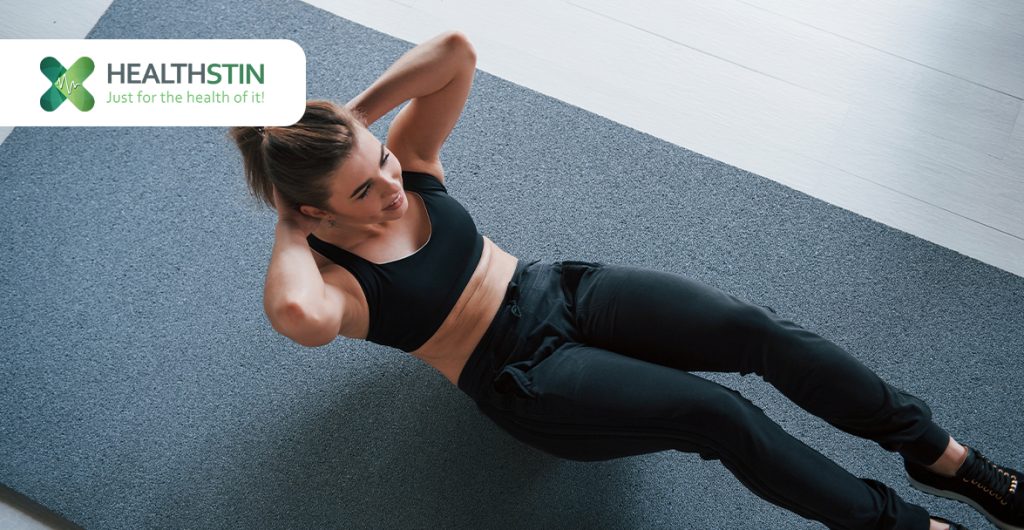
Some exercises such as crunches and sit-ups were once believed to be good for the core. Not anymore. These exercises actually work the hip flexors and may be harmful, especially for older adults, as they pull on the neck. Strengthening the hip flexors can be a good thing. However, if there’s an imbalance between these and the other core muscles, the stronger hip flexors may pull on the lower back and cause back pain.
A better strategy would be working for several core muscle groups at the same time. Here are three exercises that may help older adults develop core strength safely and effectively:
- Bridge exercises – Start by lying on your back on the mat. Lift your buttocks and hold for a few seconds. Bridges are easy to do and very effective as they help create rigidity in the whole region from the rib cage to the pelvis all the way around to the back.
- Planks – engages the core as well as the arm and shoulder muscles as you assume a push-up position.
- Arm and leg raises – Start on your hands and knees. Raise your left arm and right leg simultaneously. Do 10-15 reps. Then, do the same using the right arm and left leg.
Notice: The information provided here is general in nature. This presentation is intended for demonstrating correct exercise techniques and is not meant for self-diagnosis or self-management of your medical condition. If you experience persistent discomfort or challenges when exercising, it is prudent to consult a qualified Exercise Physiologist for guidance. Feel free to contact our experienced Allied Health Professionals at 1300 090 931.
Get to the core of health with our team of Health Experts
If you want to embark on a well-rounded health and fitness program that includes strengthening your core, why not consult our Allied Health Team at Healthstin in Hurstville by calling 1300 090 931 today! Our Exercise Physiologists and Physiotherapists are always ready to answer your questions, assess your functional capacity, design a program to strengthen your core body and teach you the proper way to exercise.
Did you learn something new or gain new insights from this post? Follow our blog or subscribe to our social media accounts on Facebook or Instagram so you won’t miss an update.





