You know you need help, but it can be hard to pick the right service. Choosing the wrong one can waste time. If therapy is delayed, progress may slow, and staying independent can be harder. Learning about the different therapy options in Sydney and how NDIS, aged care, and DVA funding work can help find support that matches your goals.
What Are Therapeutic Services?
Therapeutic services are health treatments delivered by qualified allied health professionals to help you move better, manage a health condition, and stay as independent as possible. In Australia, they may include physiotherapy, exercise physiology, hydrotherapy, occupational therapy, speech pathology, dietetics and remedial massage.
The word “therapeutic” is doing real work in that sentence. It separates this kind of care from general fitness or relaxation services. A therapeutic session has an assessment behind it, a goal attached to it, and clinical notes written afterwards that someone else on your care team can read and act on.
Allied health services in Sydney tend to group around four kinds of need:
- Physical function. Strength, balance, walking, pain, getting on and off a chair or in and out of a car.
- Cognitive and communication support. Memory strategies, speech, swallowing, and the tools that help someone be understood.
- Emotional wellbeing. Structured physical activity used deliberately to support mood, sleep and motivation.
- Everyday functional skills. The practical business of showering, cooking, catching a bus, or getting to a grandchild’s birthday party.
Not every provider covers all four. Healthstin delivers physiotherapy, exercise physiology, Hydrotherapy, and remedial massage in-house and can point you towards other services where those are a better fit.
Why Getting In Early Usually Helps
There is a practical reason clinicians push for early referral, and it isn’t sales. A function that is maintained is easier to keep than one that has to be rebuilt. Someone who starts balance work after a near miss is generally working with more to build on than someone who starts after a fractured wrist and six weeks in a sling.
Early input also gives you a documented baseline. That matters at plan review time, because it’s much easier to argue for continued funding when there are assessment numbers from six months ago to compare against.
Who Can Benefit from Therapeutic Services in Sydney?
Therapy services in Sydney reach a broader group of people than most families assume. If any of the following sounds close to your situation, it’s worth a conversation.
NDIS Participants
If your plan has therapy funding, NDIS therapeutic supports help you turn your written goals into regular activities. For example, goals like travelling on your own, moving safely, or joining a community group often involve physical skills that therapy can help you build.
Older Adults
Falls, reduced walking distance, morning stiffness, and general worry about managing at home are common reasons older Australians are referred. Strength and balance work is one of the better-evidenced interventions in this space, and it can be delivered at home if getting to a clinic is the barrier.
People Living with Disability
Disability support services help people with a long-term and serious disability to build and keep important skills. This includes safer moving, better stamina, and fewer related problems like stiff joints or pressure sores. The main goal is to help people live more independently, not just to improve medical test results.
People Recovering from Injury or Surgery
After a joint replacement, fracture, or long hospital stay, most people go home with a list of exercises but little guidance. Supervised rehabilitation services in Sydney can help by adjusting your programme as you get stronger, so you are not left to figure it out on your own.
People Living with Neurological Conditions
Conditions such as stroke, multiple sclerosis, Parkinson’s disease, cerebral palsy, and acquired brain injury influence movement, but they can be improved through systematic and repeated practice. The progress made may be more gradual and has to be assessed in a different way, and the programme should be altered as the condition changes.
People Managing Chronic Health Conditions
Type 2 diabetes, cardiovascular disease, osteoarthritis, chronic pain and long-term fatigue are all conditions where exercise is part of standard care. The value of a clinician is knowing how hard to push and when to back off, which is difficult to judge on your own.
What Types of Therapeutic Services Are Available in Sydney?
Here is how the main services compare at a glance, followed by a closer look at each.
| Service | Best Suited To | Typical Focus | Where It Happens |
| Physiotherapy | Pain, injury, mobility loss, falls risk | Movement assessment, hands-on treatment, exercise prescription | Clinic, home, community |
| Exercise physiology | Chronic conditions, disability, deconditioning | Longer-term strength, fitness and functional capacity | Clinic, gym, home, pool |
| Hydrotherapy | Painful or weight-bearing-limited movement | Low-impact strength and mobility work in warm water | Heated pool |
| Telehealth therapy | Follow-ups, coaching, review, access barriers | Programme review, technique checks, education | Video call from home |
| Remedial massage | Muscle tightness, discomfort, recovery support | Soft tissue work alongside an active programme | Clinic, home |
Physiotherapy
Physiotherapy deals with how your body moves and why it hurts. A physiotherapist assesses joint range, strength, gait and balance, then works out which part of that picture is actually limiting you. Physiotherapy services commonly cover:
- Mobility work after injury, surgery or illness
- Pain management strategies for both recent and long-standing problems
- Falls prevention through balance retraining and home safety advice
- Gait retraining, including practice with a walking aid where one is needed
Sessions usually mix hands-on treatment with exercises you take home. The take-home part is where most of the change happens, which is why a good physiotherapist spends time making the programme something you’ll realistically do.
Exercise Physiology
Exercise physiology works together with physiotherapy instead of competing with it. Whilst physiotherapy usually focuses on a specific issue, exercise physiology looks at the bigger picture by helping people with disabilities, injuries, or chronic conditions build strength, improve heart health, and increase their ability to function.
An Accredited Exercise Physiologist creates a programme based on what you can safely do right now and then helps you build on it. For example, they might start with sit-to-stand exercises for someone who needs help getting up from the couch, or set up a walking plan for someone who can only walk for ten minutes before getting tired.
This is clinical work, not a gym session with a different label. Programmes account for medication, blood pressure, fatigue patterns and any movement precautions from a surgeon or physician.
Hydrotherapy
refers to a set of exercises led by a qualified health professional and performed in a pool, using the water to support movement and exercise. The reason is that the water supports a large part of your body weight, so movements which might be painful or frightening on land are usually easier to perform in the pool.
Hydrotherapy can help people with painful joints, those who cannot put much weight on their legs after surgery, people who are afraid of falling, or those with neurological conditions that make balance difficult on land. A 2023 review in Clinical Rehabilitation examined randomised trials and found that aquatic exercise improved pain, stiffness, and physical function in people with knee osteoarthritis compared with no exercise. The pain relief lasted for at least three months. However, the same research shows that aquatic exercise is no better than land-based exercise. It should be seen as another way to reach the same goal, not a better one.
Healthstin runs Hydrotherapy in Sydney at the Sans Souci Leisure Centre and the Hurstville Aquatic Leisure Centre, both of which have accessible pool entry.
Telehealth Therapy Services
Telehealth is a video appointment with a clinician. It won’t replace hands-on treatment, and no reputable provider will claim otherwise. What it does well is everything around the hands-on part: reviewing how a home programme is going, checking exercise technique, adjusting load, answering questions before a plan review, and maintaining continuity when you’re unwell or when the weather has closed in.
For families in outer Sydney, or anyone who loses half a day to a clinic appointment, telehealth can be the difference between fortnightly contact and quarterly contact.
Need Help Finding the Right Therapy Support in Sydney?
If you’re reading this because someone in your family has started holding the handrail on the stairs, or because a plan review is coming and you still don’t know what to ask for, that’s a normal place to be. Most people arrive at allied health with a symptom, not a service in mind. Sorting out whether physiotherapy, exercise physiology or Hydrotherapy is the right starting point is our job, not yours.
A free 30-minute consultation is a straightforward way to talk it through. You describe what’s happening, we explain which service fits and how the funding side is likely to work. There is no assessment to prepare for and no obligation to book anything afterwards.
Call 1300 090 931 or send us a message if you’d rather start in writing.
How Can Therapeutic Services in Sydney Improve Quality of Life?
The clinical measures matter, but they aren’t what people notice. What people notice is that the week works better.
Increased Independence
Being able to shower without waiting for someone, or get dressed without help, changes the shape of a day. For people using funded supports, gains in independence can also mean fewer paid support hours are needed to do the same tasks, freeing up budget for other things.
Improved Mobility
Being able to walk further, stand for longer, or handle a kerb or steps are common goals in physiotherapy and exercise physiology. Achieving these makes many other activities possible.
Better Physical Health
Regular structured exercise supports blood pressure, blood sugar control, bone density and cardiovascular fitness. For someone managing more than one condition at once, an exercise programme designed around all of them beats several generic ones.
Enhanced Confidence
Concern about falling often causes changes in the way people behave even before any actual fall takes place. For example, they may decide not to go out, avoid showering on their own, or give up the kinds of activities that help them remain strong. Having balance exercises performed under supervision can help break this cycle.
Greater Community Participation
Community rehabilitation often has a specific destination attached: getting to the local shops, back to a bowls club, or onto a bus without help. Practising in the actual environment tends to transfer better than practising in a clinic.
Improved Mental Wellbeing
Structured physical activity is a recognised part of managing anxiety and low mood, and the regular contact with a clinician matters too, particularly for people who spend a lot of time alone. Therapy is not a substitute for mental health treatment, and a good clinician will say so and refer on where that’s needed.
Which Conditions Are Supported Through Therapeutic Services in Sydney?
The list below covers conditions commonly seen in disability therapy services in Sydney. Therapy supports function and symptom management in these conditions. It does not cure them, and the degree of change varies considerably between individuals.
Cerebral Palsy
Therapy usually focuses on muscle tone, joint movement, transfers, and walking. Equipment and positioning are checked as the person grows or their needs change. Cerebral palsy support is long-term and involves different professionals working together.
Multiple Sclerosis
Managing fatigue is the main focus. Multiple sclerosis programmes are paced below maximum effort, and plans are changed to fit around relapses and heat sensitivity instead of pushing through them.
Parkinson’s Disease
Therapy often includes practising big movements, working on walking and balance, and using strategies to manage freezing episodes. Being consistent is more important than working at high intensity.
Stroke
Stroke rehab aims to help people regain movement and function on the affected side, relearn how to walk, and build up endurance. Recovery goes on beyond the first few months, but the speed of progress changes over time.
Intellectual Disability
For people with an intellectual disability, the sessions follow well-defined routines and focus on practical tasks, and a support worker or a family member is usually present to help carry on the programme between visits.
Autism Spectrum Disorder
Motor coordination, strength and physical activity participation are common areas of work. Sessions for autistic participants are adapted for sensory needs, including pool temperature, noise levels and predictable session structure.
Spinal Cord Injury
Spinal cord injury rehabilitation focuses on transfers, wheelchair skills, building upper limb strength, and improving cardiovascular fitness. It also aims to prevent secondary problems like pressure injuries and shoulder overuse.
Chronic Pain Conditions
Graded activity, pacing and gradual exposure to feared movements are the mainstay. Progress is usually measured by what you can do rather than by pain score alone, and setbacks are treated as part of the process rather than a failure.
What Is Multidisciplinary Care, and Why Does It Matter in Sydney?
Multidisciplinary care means two or more health professionals from different disciplines working together on the same plan for the same person, sharing information and coordinating their respective roles. It is different from simply seeing several therapists, because the coordination is deliberate rather than left to the client.
The difference becomes clear in everyday situations. For example, if a physiotherapist notices that a client’s knee hurts more than usual and their walking has changed, a coordinated team will ensure the exercise physiologist is informed before the next session. This way, the programme can be adjusted that same week. In a less connected setup, the client has to notice the issue, bring it up at their next appointment two weeks later, and then wait for a review.
In practice, multidisciplinary care usually involves:
- Sharing clinical notes, so you do not have to repeat your medical history at every appointment
- Having a clear process to review your care plan when your condition changes
- Holding case conferences that include your support coordinator or care manager, not just the clinicians
- One point of contact when something changes, rather than four separate phone calls
There is research behind the approach as well. A systematic review in the Journal of Multidisciplinary Healthcare found interdisciplinary team-based care was associated with improvements in activities of daily living for people with Alzheimer’s disease, and studies in inpatient stroke rehabilitation have reported better functional recovery alongside more controlled long-term costs where team-based care is used.
Understanding Funding Options for Therapeutic Services in Sydney
This is the part that stops most people. Here is how the main pathways compare, followed by the detail on each.
| Funding Stream | Who It Is For | How Therapy Is Usually Accessed |
| NDIS | People under 65 with permanent and significant disability | Capacity Building budget, tied to plan goals |
| Support at Home | Older Australians assessed for in-home aged care | Clinical care category of your quarterly budget |
| DVA | Eligible Veteran Card holders | GP referral under treatment cycle arrangements |
| Medicare (GPCCMP) | People with a chronic condition, via their GP | Up to 5 subsidised allied health services per calendar year |
| Private health insurance | Members with relevant extras cover | Rebate at point of service, varies by fund and policy |
| Workers compensation / CTP | People injured at work or in a motor vehicle | Insurer approval, usually via a certificate of capacity |
NDIS Funding
Every NDIS plan is built from four support budgets: core, capacity building, capital and recurring. Across those budgets sit 21 support categories. Therapy almost always comes from NDIS allied health funding in the capacity building budget, under Improved Daily Living, and it is a stated support, meaning that money cannot be moved to something else.
How you can spend it depends on how your plan is managed. Self-managed and plan-managed participants can choose registered or unregistered providers. NDIA-managed participants need to use a registered provider.
Support at Home (Previously Home Care Packages)
If you are familiar with Home Care Packages, that programme has now ended. Support at Home took its place alongside the Short-Term Restorative Care Programme, starting on 1 November 2025. There are now eight funding categories instead of four, and budgets are set every quarter instead of once a year.
For therapy needs, clinical supports is the category that includes nursing and allied health services. There is also a Restorative Care Pathway, which offers short, focused periods of allied health support to help people regain function. This is funded separately from the regular categories.
DVA Funding
You can use DVA Health Cards (Gold and White) to pay for services if you have a referral from your GP.
Medicare Programmes
From 1 July 2025, new GP Management Plans and Team Care Arrangements have been replaced by a single GP Chronic Condition Management Plan. If your GP creates one for you, you could get up to five Medicare-subsidised allied health visits each year, which you can use for different types of care. Referrals still need to be in writing, but there is no longer a set form or a required number of visits.
Whilst five services may be useful, they probably won’t meet all of your continuing therapy needs. In light of your individual circumstances, you should consider discussing with your healthcare provider other ways of funding or paying for treatment. If you already have a GP Management Plan or a Team Care Arrangement that was in place before 1 July 2025, you can continue to use it for eligible services until 30 June 2027.
Private Health Insurance
Most extras policies include some physiotherapy cover, and many include exercise physiology and remedial massage. Rebate amounts, annual limits and waiting periods vary widely between funds, so check your policy rather than assuming.
Workers Compensation and Motor Accident Claims
If you were injured at work or in a car accident, you might be able to get your treatment paid for by the Workers’ compensation or motor accident insurer. The rules for funding and approval vary by state, insurance scheme, and type of treatment. You may need to have an accepted claim, provide medical documents, get referrals, or submit a treatment plan.
How Do You Choose the Right Therapeutic Service Provider in Sydney?
Provider websites all say much the same things. These six questions get you past that.
Experience with Your Condition
Ask directly how often the team works with your condition, and what a typical programme looks like. A provider who sees spinal cord injury weekly will answer differently from one who has seen it twice.
Range of Services Offered
If you are likely to need more than one discipline, having them under one organisation saves you from being the messenger between clinics. Ask what happens if your needs change partway through.
Flexible Service Delivery
Clinic, home, community, pool and telehealth are all legitimate settings, and the best one changes over time. Ask whether the provider can move between them without you having to start again with a new clinician.
Goal-Focused Care
Ask how goals are set, written down and reviewed. You should be able to see your goals in your own words somewhere in the paperwork, not translated into clinical language you don’t recognise.
NDIS and Funding Knowledge
Reports and paperwork are a real part of this. A provider who understands plan reviews, reporting timeframes and what a plan manager needs on an invoice will save you a lot of chasing. Ask how quickly progress reports are turned around.
Clinician Qualifications and Registration
Physiotherapists are registered with AHPRA, and you can check any practitioner on the public register. Exercise physiologists are accredited through ESSA, which is self-regulated rather than AHPRA-registered. Both are legitimate credentials, but they work differently, and it is reasonable to ask which applies to the person you’ll be seeing.
Why Are More Sydney Residents Choosing Community-Based Therapy?
Clinic-based care has clear advantages: full equipment, a controlled space, other clinicians a few metres away. But a growing share of therapy in Sydney happens where people actually live, and there are practical reasons for that.
- Travel disappears. For someone who needs a carer to attend an appointment and paid transport to get there, a clinic visit can cost several hours and multiple people’s time.
- The rehabilitation is real-world. Practising steps on your own back stairs, with your own handrail, transfers better than practising on a standard clinic step.
- Families get involved. Home-based therapy, delivered on a home visit, means the person who helps you every day can watch the session and learn the technique rather than receiving a printout.
- Problems get spotted. A clinician in your home sees the rug that slides, the toilet that’s too low and the doorway that’s too narrow. None of those shows up in a clinic.
The trade-off is honest and worth stating: home visits carry travel time, equipment is limited to what fits in a car, and availability depends on where you live. Healthstin generally takes home visits within about a 30-minute drive of a clinic, which for Sydney means the areas around Sans Souci and Hurstville. That radius is what keeps visits practical to schedule, so the quickest way to find out is to give us your postcode.
Why Choose Healthstin for Therapeutic Services in Sydney?
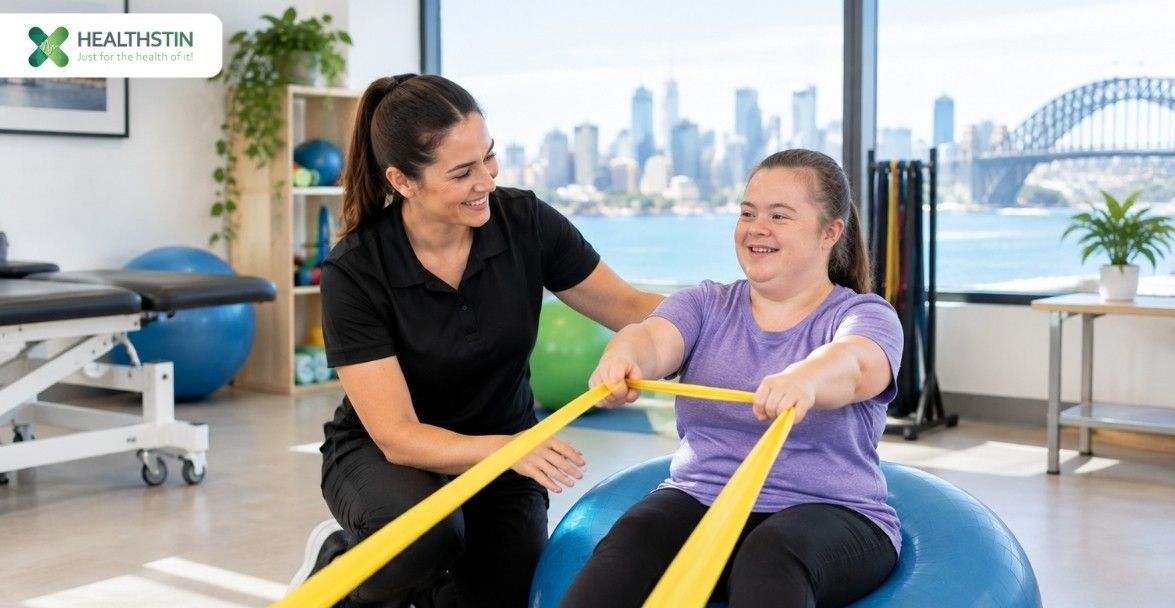
Healthstin is a multidisciplinary allied health provider delivering physiotherapy, exercise physiology, Hydrotherapy and remedial massage. In Sydney, that happens across two clinic sites, in people’s homes, in the community, and by telehealth.
- Two Sydney locations. Sans Souci at the Sans Souci Leisure Centre, serving southern Sydney, and Hurstville at the Hurstville Aquatic Leisure Centre, convenient for the St George area. Both have Hydrotherapy pool access.
- Home and community visits across Greater Sydney for people who can’t easily reach a clinic.
- Telehealth appointments for reviews, programme adjustments and continuity between in-person sessions.
- Multiple funding streams, including NDIS, aged care, DVA, Workers’ compensation and private clients.
- Coordinated care, with clinicians sharing notes and reviewing plans together rather than working in parallel.
- Goal-focused plans written around what you want to be able to do, and reviewed as that changes.
- Healthstin is a registered NDIS provider.
Worth being straight about the limits too. Availability differs between suburbs, some services are tied to a particular site, and no provider can promise a specific clinical result. What can reasonably be promised is a clear assessment, a plan you understand, and someone who tells you if a different service would suit you better.
FAQs About Therapeutic Services in Sydney
1. What therapeutic services are available in Sydney?
Physiotherapy, exercise physiology, hydrotherapy, occupational therapy, speech pathology, dietetics and remedial massage are all available across Sydney. Healthstin provides physiotherapy, exercise physiology, Hydrotherapy, and remedial massage directly, with clinics at Sans Souci and Hurstville, plus home, community, and telehealth options.
2. Which therapy service is right for me?
It depends on what you’re trying to change. Pain and a recent injury usually point to physiotherapy. Long-term strength, fitness and chronic condition management point to exercise physiology. If land-based movement is too painful or you’re worried about falling, hydrotherapy may be a better starting point. An initial assessment sorts this out properly.
3. Can NDIS funding cover therapeutic services?
Therapy is generally funded from the capacity building budget under Improved Daily Living, provided it relates to your disability and links to a goal in your plan. Whether it is included in your particular plan depends on what the NDIA has assessed as reasonable and necessary.
4. Do therapeutic services improve independence?
For many people, yes, though the extent varies a great deal depending on the condition, how long it has been present and how consistently the programme is followed. Independence gains are usually gradual and specific, such as managing a transfer alone or walking further before resting, rather than dramatic overall change.
5. Are home visits available?
Yes. Healthstin clinicians provide home and community visits across Greater Sydney. Availability and travel arrangements vary by suburb, so it’s worth checking your postcode when you enquire.
6. What is the benefit of multidisciplinary care?
Fewer gaps between what each clinician knows, faster adjustments when something changes, and less repetition of your history at every appointment. It also means one person can flag when a different discipline would help, instead of you having to work that out yourself.
Take the Next Step Towards Better Movement and Independence with Healthstin for Therapeutic Services in Sydney
Whatever brought you here, the practical goal is usually specific: getting up from a chair without help, walking to the letterbox and back, sleeping through the night without your shoulder waking you. Those are the kinds of goals a therapy plan is built around, and they’re the ones worth naming out loud at a first appointment.
You can book an assessment online at a time that suits you. The clinician will assess where you are now, talk through what you want to be able to do, and build a plan around that. If a different service would suit you better than the one you booked, they’ll tell you.
If a referral is already in hand, our referral form is the quickest way through. Otherwise, call 1300 090 931, and we’ll take it from there.
Disclaimer: This article is general information only and is not a substitute for individual medical advice or advice about your NDIS plan, aged care funding or insurance claim. Therapy outcomes vary among individuals, and no particular result can be guaranteed. Funding rules change. Confirm current details with the NDIS, My Aged Care, the Department of Veterans’ Affairs, your GP or your Healthstin team. If your symptoms are new, worsening or severe, speak with your doctor.