It can be tough for wheelchair users to stay active. Many exercise tips do not fit your needs, so figuring out how to begin is not always easy. Without proper guidance, you might skip exercise or push yourself too hard.
This gap matters. If you do not work on your upper body regularly, the muscles you use for pushing your wheelchair, making transfers, and doing daily tasks can get weaker over time. The right seated strength exercises for disability needs can help. Whether you are an NDIS participant, a carer, or simply want to move better and feel stronger, this guide gives you a safe and practical place to start.
Why Upper Body Strength Is Essential for Wheelchair Users
Consider all the ways you use your upper body each day: pushing your chair, lifting yourself during transfers, reaching for items on a shelf, or keeping steady whilst getting dressed. For wheelchair users, the arms, shoulders, and core are always at work. If these muscles are not strong enough, everyday tasks can become much more difficult.
This is why doing wheelchair upper body workouts is not only about staying fit. It is also about making daily life easier.
- It keeps you moving
When your arms and shoulders are stronger, pushing your wheelchair takes less effort. This means you can move around more easily, whether you are at home or out in the community.
- It supports safer transfers
Transferring between your wheelchair and other surfaces is one of the most challenging daily activities. It takes coordinated arm strength and core support to do it safely. Regular arm exercises help you build these skills, making transfers safer and more controlled.
- It protects your shoulders
Many wheelchair users experience shoulder pain, often because of repeated strain on muscles that are not well-conditioned. Resistance training that builds shoulder stability helps share the workload and keeps your joints healthier for longer, which is important for preventing injuries.
- It improves your posture
If your back and core muscles are weak, it can be tough to sit upright all day. This can lead to slouching, tension, and discomfort. Seated strength exercises help you keep better posture, reduce pain, and even improve your breathing.
Safety Tips Before Starting Exercises
Before you begin any wheelchair workout, take a few minutes to prepare. These tips are important because they help you make progress and avoid injuries.
Tip #1: Always Warm Up
Think of your warm-up as preparation, not a waste of time. Spending five to ten minutes on gentle shoulder rolls, neck movements, and light arm swings before you exercise helps your muscles and joints ease into the work ahead. This is especially important for wheelchair users, since your shoulders and arms are already under load throughout daily living activities. They need a proper chance to transition into more focused exercise.
Tip #2: Protect Your Shoulders
Shoulder stability is very important for wheelchair users. Your shoulders already do a lot of repetitive work like pushing, reaching, and transferring, so they are more likely to get strained than many people realise. Avoid exercises that cause sharp pain or pinching, and never push through shoulder discomfort. Preventing injury starts with listening to your body before problems get worse.
Tip #3: Focus on Proper Techniques
Good form is more important than how much weight you lift or how many reps you do. Poor technique not only makes the exercise less effective, but it also puts extra stress on your joints and can cause real damage over time. If you are not sure if you are moving correctly, working with an experienced NDIS exercise physiology wheelchair professional is a great way to learn proper technique from the beginning.
Tip #4: Build Up Slowly
If you are new to exercise or coming back after a break, always start with less weight than you think you need. Building strength takes time, and moving too quickly is a common reason people get hurt. Using a light resistance band or small weights helps your muscles and joints adjust slowly. This leads to better long-term results and helps you keep exercising regularly.
7 Best Upper Body Exercises for Wheelchair Users
The following workout routines are good arm exercises for wheelchair users at any fitness level. Each one focuses on the muscles you use most, helping you get stronger and making daily tasks easier.
You don’t need a gym or expensive equipment to begin. A resistance band, some light dumbbells, and a sturdy wheelchair are all you need. Move with control and take your time as you exercise.
1. Seated Resistance Band Rows
This exercise is great for wheelchair users who want a stronger back and better posture. It works the muscles between and below your shoulder blades, which often get weak from sitting for long periods and reaching forward during the day.
Seated Resistance Band Rows
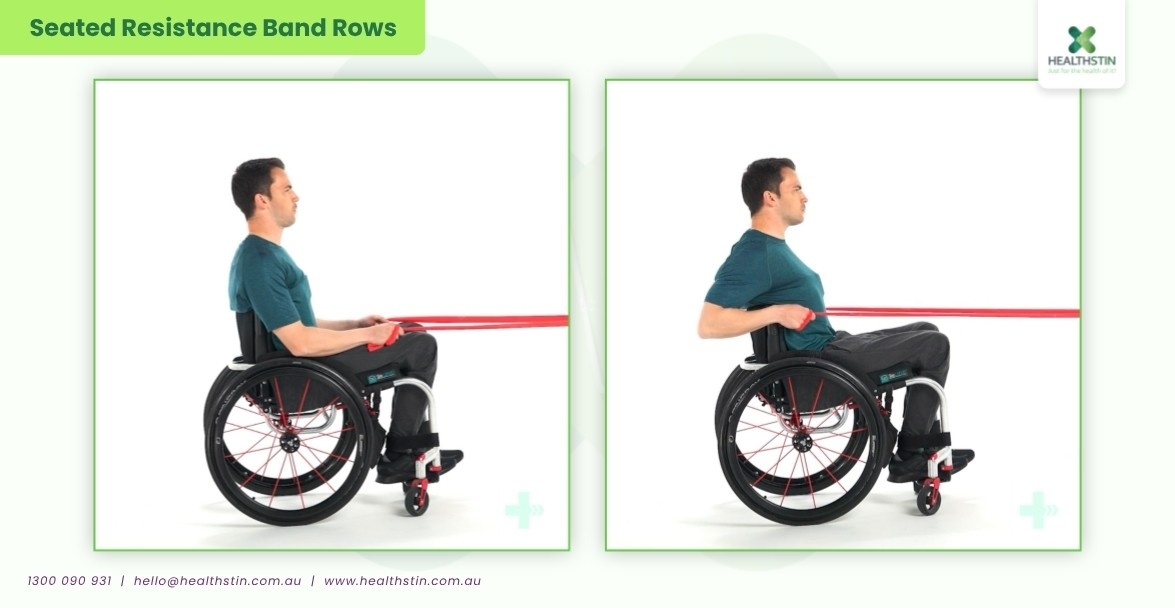
Instructions:
- Sit up straight in your wheelchair and make sure the brakes are on.
- Rest your feet firmly on the footrests.
- Fasten a resistance band to something sturdy in front of you, around waist level.
- Hold one end of the band in each hand, keeping your elbows bent at about 90 degrees.
- Pull the band just enough so you feel a gentle tension.
- Slowly pull your elbows back and bring your hands closer to your body.
- Whilst you pull, gently squeeze your shoulder blades together.
- Pause for a moment when you reach the end of the movement.
- Slowly bring your arms back to the starting position, keeping the movement controlled.
- Repeat the exercise as many times as your instructions say.
Helpful Tip:
Keep your chest up and your shoulders relaxed the whole time. Try not to shrug your shoulders as you row.
2. Shoulder Press (Seated)
Strong shoulders can make daily tasks much easier than you might think. Whether you are reaching for something on a shelf or maintaining balance during a transfer, your shoulders support many important movements. This exercise targets your shoulders directly, and if you do it regularly, it can be one of the best parts of your wheelchair upper-body routine.
Seated Shoulder Press
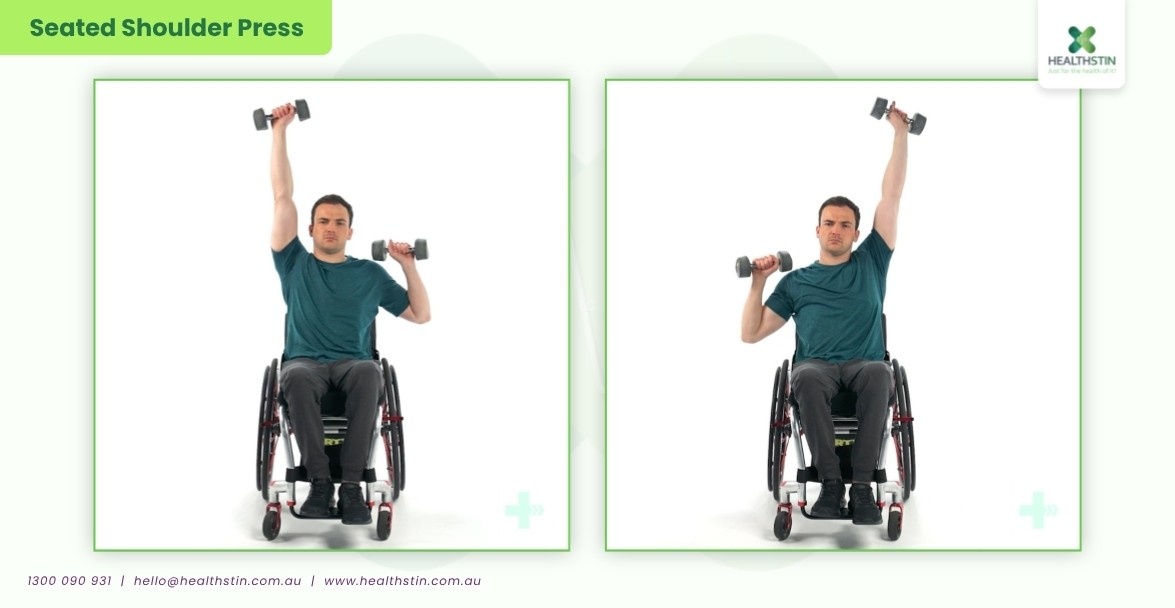
Instructions:
- Sit up straight in your wheelchair and make sure the brakes are on.
- Rest your feet firmly on the footrests.
- Hold a dumbbell in each hand at shoulder level, keeping your palms facing forward.
- Slowly push one dumbbell up until your arm is straight above your head.
- Pause for a moment at the top.
- Lower the dumbbell back down to your shoulder slowly and with control.
- Do the same movement with your other arm.
- Keep switching arms until you finish the set number of repetitions.
Helpful Tip:
Sit up straight and try not to lean to one side whilst pressing. Use a range of motion that feels good for you and keep your movements steady and controlled during the exercise.
3. Chest Press with Resistance Band
The chest press might look simple, but it does a lot for your body. It works your chest, the front of your shoulders, and the back of your upper arms with one push. If you use a wheelchair, you probably use this kind of strength more often than you realise, whether you are moving things aside or keeping yourself steady throughout the day.
Resistance Band Chest Press
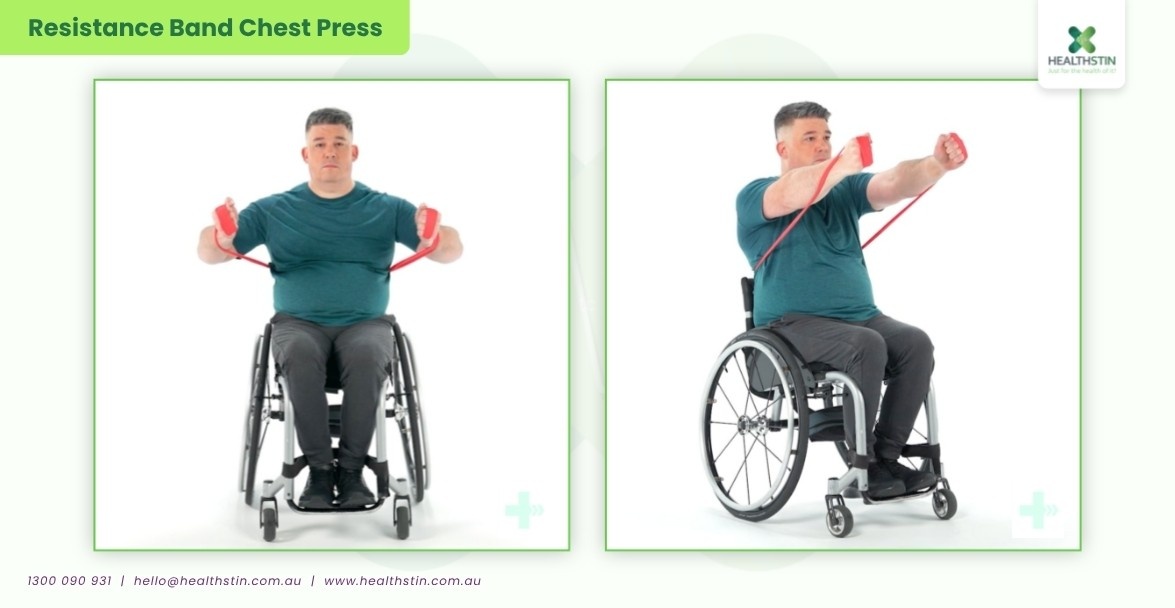
Instructions:
- Sit up straight in your wheelchair and make sure the brakes are on.
- Rest your feet firmly on the footrests.
- Put a resistance band behind your chair, keeping it about chest high.
- Hold one end of the band in each hand. If you need more tension, wrap the band around your hands a bit.
- Raise your elbows out to the sides until they are even with your shoulders.
- Slowly push your hands forward until your arms are straight in front of you.
- Pause for a moment when your arms are fully extended.
- Slowly bring your hands back to where you started, keeping the movement steady.
- Repeat this exercise as many times as your instructor recommends.
Helpful Tip:
Keep your shoulders relaxed and avoid leaning forward whilst pressing. Try to move smoothly and steadily throughout the exercise.
Looking for a Personalised Exercise Programme?
General exercise guides are a good place to start, but they only go so far. If you are an NDIS participant or support someone who is, working with a qualified exercise physiologist means each session is designed for your body, your goals, and your life.
At Healthstin, our clinicians have experience in NDIS exercise support for wheelchair users and people with movement difficulties. We take the time to understand your condition, your goals, and how exercise can help you stay independent and handle daily tasks. Then we create a programme that perfectly fits your needs.
Book a free 30-minute consultation to talk with our team, ask about your NDIS supports, and see how a structured wheelchair upper body workout could improve how you feel and function each day.
4. Bicep Curls
Bicep curls have stood the test of time because they really do work. For wheelchair users, strong biceps mean much more than just looking fit. They help you lift, pull, and carry during all the small but important tasks you do every day. With this exercise, what you gain in the gym directly helps you in daily life.
Seated Bicep Curls
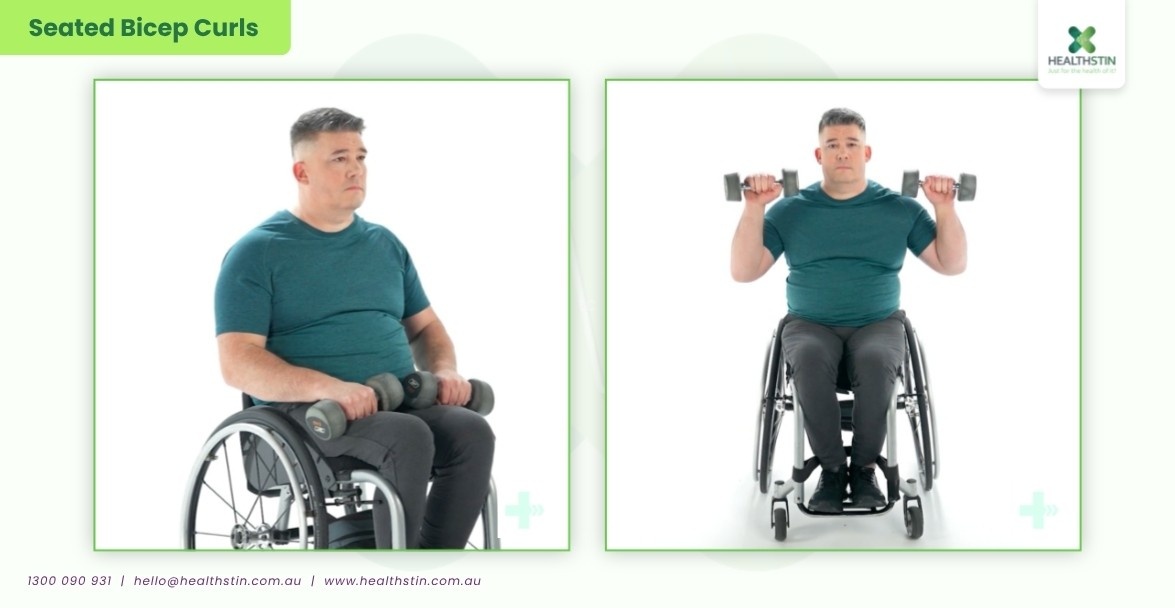
Instructions:
- Sit up straight in your wheelchair and make sure the brakes are on.
- Rest your feet firmly on the footrests.
- Hold a weight in each hand, keeping your palms facing up.
- Keep your elbows tucked in by your sides during the whole exercise.
- Slowly bend your elbows to lift the weights up toward your shoulders.
- Pause for a moment when the weights reach the top.
- Lower the weights back down slowly and with control.
- Repeat the exercise as many times as your instructor recommends.
Helpful Tip:
Keep your upper arms steady and avoid swinging the weights. Aim for smooth, controlled movements from start to finish.
5. Tricep Extensions
Biceps often get most of the attention, but triceps, which run along the back of your upper arm, are actually more important for wheelchair users in daily life. Whenever you push down on your armrests to lift yourself, press up from a surface during a transfer, or reach for something, your triceps are doing most of the work. This exercise targets them directly.
Seated Tricep Extensions
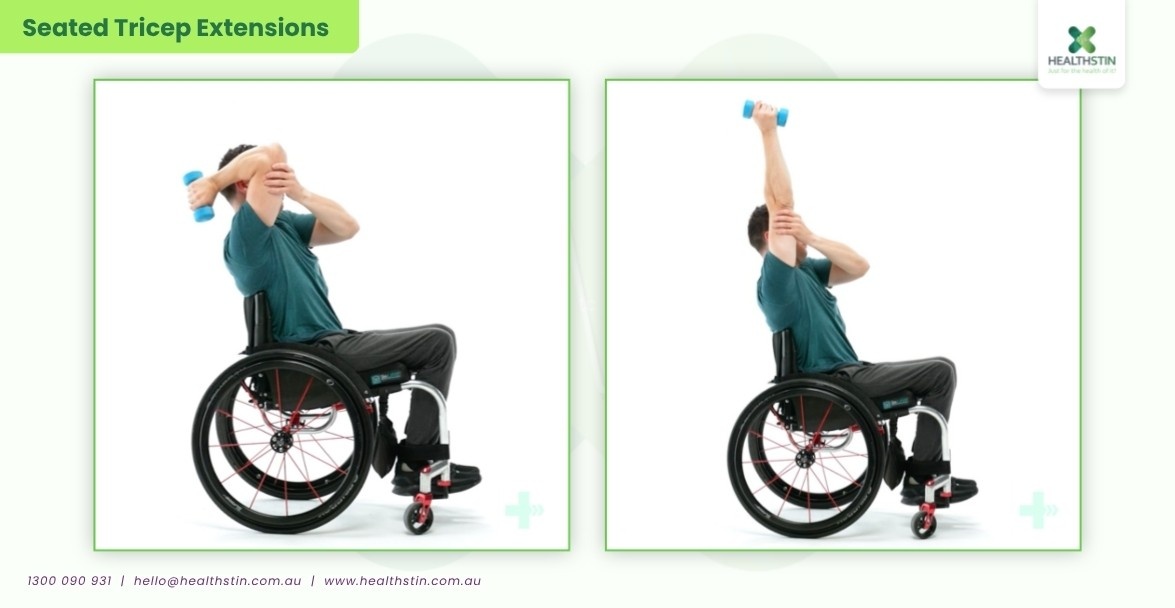
Instructions:
- Sit up straight in your wheelchair and make sure the brakes are on.
- Rest your feet firmly on the footrests.
- Hold a weight in one hand and lift your arm up toward the ceiling.
- If needed, use your other hand to help support the arm you are lifting.
- Slowly bend your elbow and lower the weight behind your head, aiming toward your shoulder blade.
- Keep your upper arm pointing up the whole time.
- Pause for a moment when you reach the bottom.
- Then straighten your elbow to bring the weight back up to where you started.
- Repeat this movement as many times as your instructions say, then switch arms.
Helpful Tip:
Make sure your elbow stays pointed up and keep your back straight. As you get stronger, try doing the exercise without help from your other hand.
6. Wheelchair Push Practice
Practising wheelchair pushes in a structured way is a great, often-overlooked way for wheelchair users to build functional strength and endurance. You don’t need any extra equipment, and it easily fits into your daily routine. The benefits, like stronger arms, better endurance, and more efficient pushing, make a real difference in everyday life—not just during workouts.
Wheelchair Push Practice
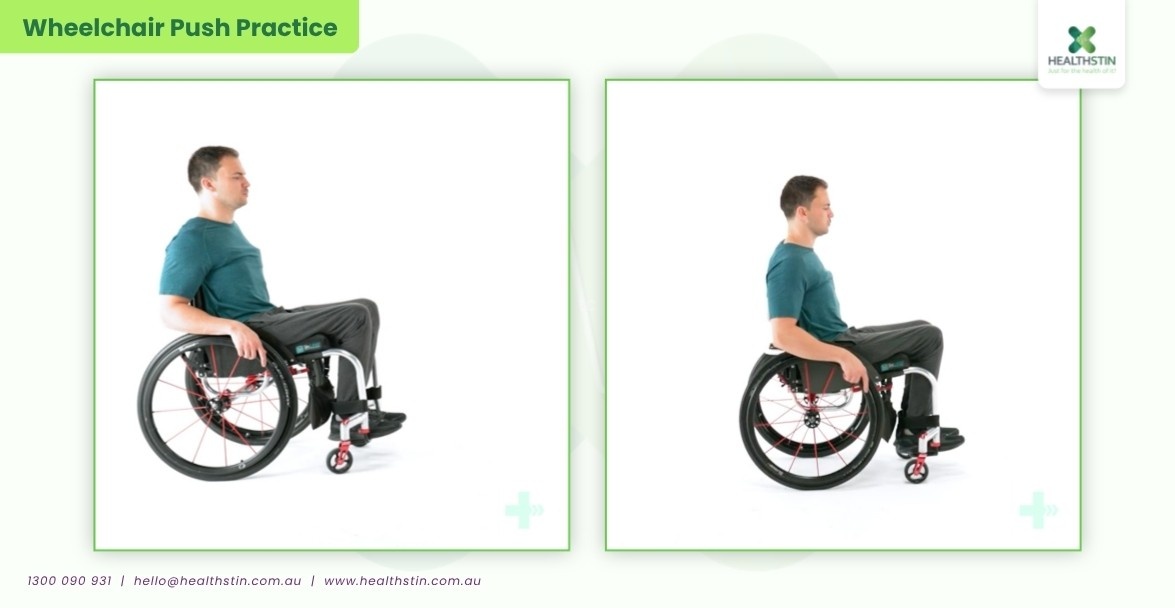
Instructions:
- Sit up straight in your wheelchair and make sure your feet are resting securely on the footrests.
- Put your hands on the push rims a little in front of your body.
- Keep your elbows close to your sides as you start moving.
- Push down and forward on the rims to move your wheelchair forward.
- Let your hands release and return to where you started on the rims.
- Repeat this movement with smooth, steady pushes.
Helpful Tip:
Try using shorter, controlled pushes with your hands farther forward on the rims, rather than reaching far behind you. This method can help reduce strain on your shoulders and improve the effectiveness of your pushes.
7. Core Stability Exercises (Seated)
Many participants forget about core strength when working on wheelchair fitness, but it is key to almost everything you do. A strong core helps you sit up straight, stay steady, and keep your balance all day. It supports every push, movement, and reach. If your core is weak, even strong arms might not work as well as they could.
Seated Trunk Rotations
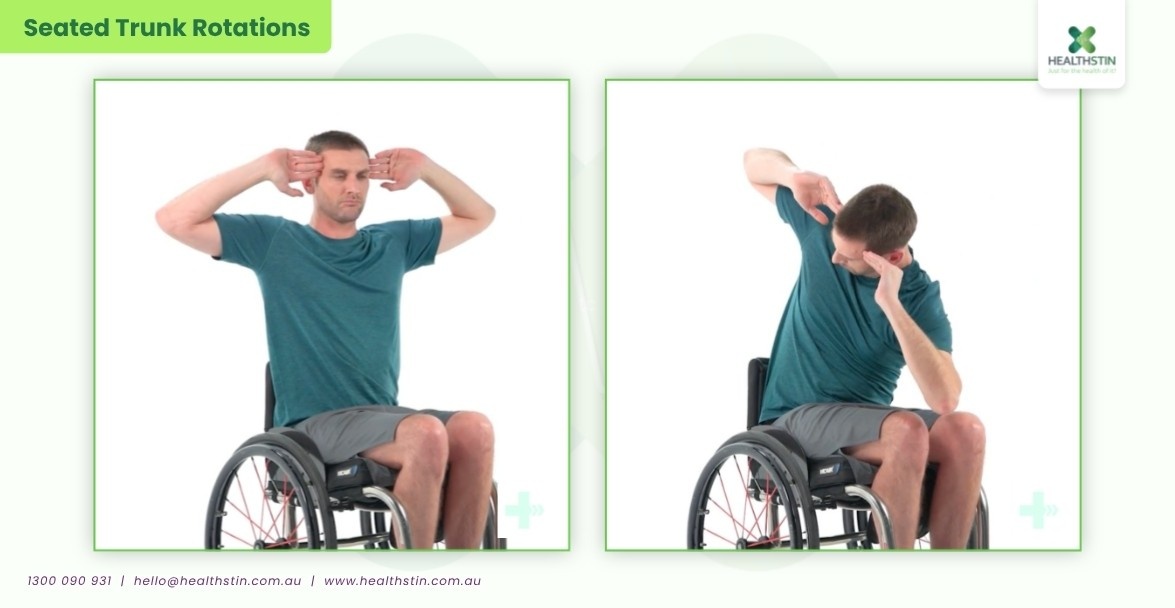
Instructions:
- Sit up straight in your wheelchair and make sure the brakes are on.
- Rest your feet firmly on the footrests.
- Put your hands next to your head and bend your elbows.
- Slowly turn your upper body to one side.
- As you turn, bring one elbow toward your opposite knee.
- Let your eyes follow the movement by looking down at the floor as you twist.
- Slowly return to your starting position.
- Repeat the movement on the other side.
- Keep switching sides as instructed.
Helpful Tip:
Move slowly and pay attention to using your core muscles to control each twist. Only turn as far as feels comfortable for you.
How to Structure a Weekly Exercise Routine
Having a list of exercises is a good start, but figuring out how to combine them into an effective routine can be tricky. A solid workout plan helps you make steady progress with each exercise. Without one, you might not see results, or you could overdo it and end up tired or injured.
Here’s an easy way to start building your routine:
- Frequency — Aim for 2 to 4 sessions each week
If you’re new to structured exercise or coming back after a break, begin with two sessions a week. This helps your body adapt without wearing you out. After four to six weeks, most people can add a third session, and later a fourth, as they get fitter and more confident. Try to spread your workouts across the week instead of doing them all at once. This gives your muscles time to recover and get stronger.
- Sets and Reps — Keep it simple at first
Start with 2 or 3 sets of 10-12 reps per exercise. This helps you build strength and endurance without putting too much stress on your joints at the start. Rest for 60 to 90 seconds between sets, giving you time to recover whilst keeping you moving. If you can do 10 reps easily with good form, it’s time to make things harder. If you can’t reach 8 reps with control, the weight is probably too heavy.
- Progression — Increase your challenge slowly
Progression is what helps you keep improving, but it’s important to take it slow. Only add more weight or reps when your current routine feels comfortable for two sessions in a row. Trying to move ahead too fast is a common reason people get injured instead of making progress, especially for those in wheelchairs. Taking small, steady steps will help you get better results than making big jumps and risking setbacks.
Sample Weekly Schedule:
| Day | Focus |
| Monday | Rows, shoulder press, chest press — 3 sets each |
| Wednesday | Bicep curls, tricep extensions, core stability — 3 sets each |
| Friday | Full upper body session + wheelchair push practice |
| Tuesday/Thursday/Weekend | Rest or gentle movement and stretching |
Begin with this plan and see how your body feels. If you often feel tired or your joints hurt, take a step back and give yourself more time to recover before moving forward.
Common Mistakes to Avoid
It’s just as important to avoid these common mistakes as it is to do the exercises correctly. Remember them from your very first session.
- Overloading the Shoulders
Your shoulders already work hard every day from using a wheelchair. If you add too much resistance too quickly, you can easily get overuse injuries. Increase weight slowly and treat your shoulders with care. Injury prevention starts with knowing your limits.
- Exercising With Poor Posture
Doing each repetition with rounded shoulders or a slouched back can lead to habits that are tough to change later. Sit up straight, keep your stomach muscles gently tight, and focus on good form rather than lifting heavier weights.
- Not Resting Enough
Muscles repair and grow when you rest, not whilst you are working out. If you train too often without enough recovery, you will get tired and risk injury. Taking two or three rest days each week is an important part of the programme, not a shortcut.
- Skipping the Warm-Up
If you use a wheelchair, your shoulders and wrists are already working before you start exercising. Skipping a warm-up makes it much more likely you will strain something. Doing five to ten minutes of gentle movement before each session is a simple way to protect yourself for the rest of your workout.
When to Seek Professional Support
Working out on your own can be useful, but sometimes it’s important to get help from a professional. Consider reaching out to a qualified clinician if any of these situations apply to you:
- You feel pain during or after exercise — It’s normal for your muscles to feel tired, but joint pain or ongoing soreness is not. It’s always a good idea to get checked early.
- Your movement feels limited — Improving your mobility often requires a plan made just for you, which a general exercise guide can’t always provide.
- You have a complex or long-term condition — Conditions like spinal cord injuries, cerebral palsy, or MS need more than a standard programme. They require a clinician who understands these specific needs.
- You are recovering from an injury — Achieving the right balance between rebuilding and not overdoing it can be tricky. A professional can help you avoid guessing and guide you safely.
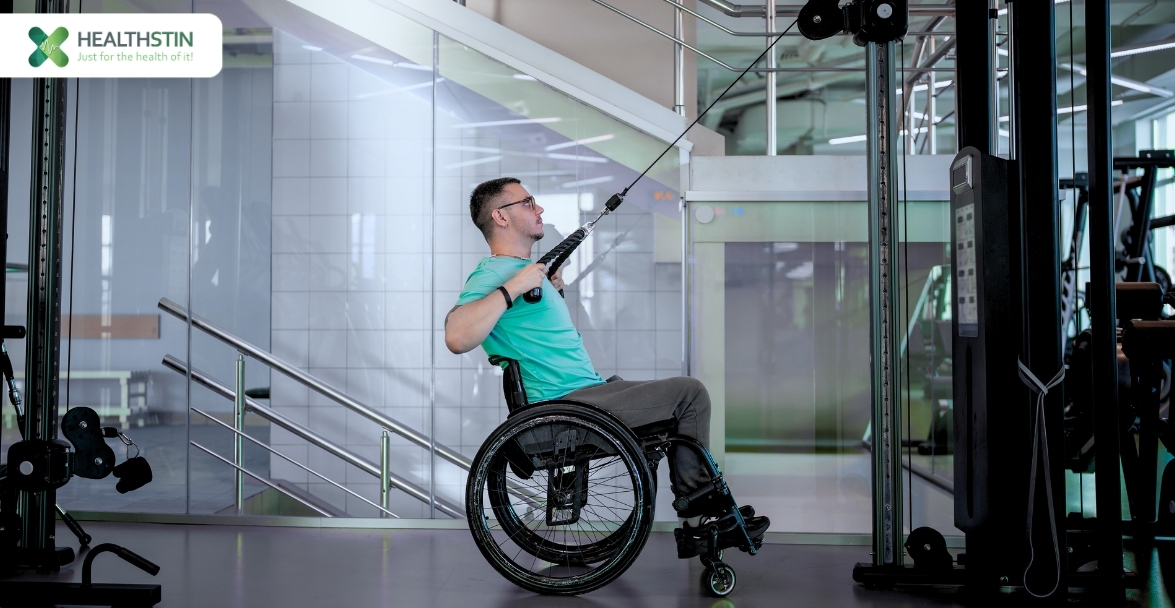
How Healthstin Supports Wheelchair Users
The right support can make a big difference. At Healthstin, we design our services to meet the needs of wheelchair users and their carers. Here’s what you can look forward to when you choose us:
Personalised Exercise Programmes
We never use one-size-fits-all plans. We get to know your condition, your daily routine, and your goals. Then we build a programme just for you, with a focus on mobility improvement and an easier everyday life.
NDIS-Funded Services
Our exercise physiology and physiotherapy services are available under NDIS funding. We work directly with participants and support coordinators to make it as straightforward as possible to access the right support.
Home and Community Sessions
Accessibility is important to us. We offer sessions wherever works best for you: at home, in your local community, or at our clinic. This way, location never gets in the way of your support.
Ongoing Progress Evaluation
We check your progress regularly and update your programme when needed. This helps you keep moving toward your next goal rather than just staying where you are.
FAQs About Upper Body Exercises for Wheelchair Users
1. Are these exercises safe for all wheelchair users?
Most of the exercises in this guide work well for many wheelchair users, but everyone’s needs are different. If you have a complex condition, are recovering from an injury, or haven’t exercised in a whilst, it’s a good idea to talk to an exercise physiologist before you begin. They can help you figure out which movements are right for you and adjust anything that doesn’t fit.
2. Can I do these at home?
Yes, most of these exercises need very little equipment and can be done easily at home. A resistance band and a pair of light dumbbells are enough to start most of the programme. Besides that, you just need a stable wheelchair and a bit of space to move.
3. How often should I exercise?
Begin with two or three sessions each week and increase as you go. This is enough to see real progress without pushing too hard at first. When these sessions feel easier, and your body has gotten used to them, you can add a fourth session.
4. Do I need equipment?
You only need a little equipment. One resistance band is enough for most of the programme. For core stability exercises and wheelchair push practice, you don’t need any equipment. If you want to go beyond band resistance, a light pair of dumbbells can help, but you don’t need them to begin.
5. Can exercise reduce shoulder pain?
For many people, yes. Building up certain muscles and improving posture can help reduce shoulder pain and keep you moving well over time. But if you already have pain, check with a professional before starting. The right exercises can help, but the wrong ones might make it worse.
Start a Safe and Effective Exercise Programme
Getting started on your journey to better strength and independence can be simple. At Healthstin, our experienced exercise physiologists help wheelchair users and NDIS participants create programmes that are practical, safe, and fit into everyday life.
No matter if you are new to exercise or want to build on your current routine, we are here to help you move better, feel stronger, and enjoy each day more.
Call 1300 090 931 to book your assessment with Healthstin today. You can also fill out our booking form to start your journey to becoming stronger and more independent.
*Disclaimer: The exercises and information in this article are meant as general guidance only and do not replace advice from a qualified healthcare professional. Exercise programmes should always be personalised. Before starting any new exercises, talk to a physiotherapist, exercise physiologist, or your healthcare provider to make sure they are safe and right for you.