
Most of us have been told to move more. That advice is fine until you’re managing type 2 diabetes, recovering from a stroke, living with cerebral palsy, or trying to get back on your feet after a hip replacement. Then “just do some exercise” stops being useful.
Without the right advice, it is easy to make mistakes. Some people push themselves too much and make an old injury worse. Others take it too easy and do not see any progress. Sometimes, a scare makes people stop altogether, and the fear of getting hurt again becomes another obstacle. Either way, the main health issue remains.
An Accredited Exercise Physiologist (AEP) Perth residents can see is a university-qualified health professional who prescribes exercise as treatment. Not a general workout. A programme built around your diagnosis, your current ability, and what you actually want to be able to do again.
Below we cover what AEPs do, why accreditation matters, which conditions they support, how funding works through the NDIS, DVA, aged care and Medicare, and what to ask before you book.
What Is an Accredited Exercise Physiologist (AEP) in Perth?
An Accredited Exercise Physiologist is a university-qualified allied health professional who uses evidence-based exercise to treat injury, disability and chronic health conditions. Accreditation is granted by Exercise & Sports Science Australia (ESSA), the profession’s national body.
That is the short answer. Here is what sits behind it.
To become an ESSA Accredited Exercise Physiologist in Perth, you complete a four-year accredited degree, or a related degree plus an accredited postgraduate qualification, along with 500 hours of supervised practical placement. Of those hours, 360 are with clients who have clinical conditions rather than with generally healthy people.
AEPs are dual accredited. They also hold accreditation as an Accredited Exercise Scientist, and they build clinical practice on top of that foundation. ESSA’s AEP Scope of Practice sets out the minimum activities and standards for the role.
Exercise physiology is self-regulated rather than AHPRA-registered. ESSA’s requirements sit under the national framework set by the National Alliance of Self-Regulating Health Professions, and AEPs are recognised as allied health professionals by the NDIS, the Department of Veterans’ Affairs, Medicare and most private health funds.
A Clinical Exercise Physiologist in Perth sees clients day-to-day, assesses how you move, screens for risk, prescribes a programme, then adjusts it as your capacity changes. Where that happens depends on the provider. Some work from a clinic, gym or Hydrotherapy pool. Others come to you at home, meet you at a local park, or run sessions over video.
Why Does Accreditation Matter?
Anyone can use the title trainer or coach. An “Accredited Exercise Physiologist” meets a set professional standard, and this difference has real benefits for you.
Clinical training and reasoning
Four years of anatomy, physiology, pathophysiology and exercise prescription, plus supervised placement hours with people who have genuine clinical conditions. AEPs are trained to work around medications, multiple conditions at once, and symptoms that shift from week to week.
Evidence-based treatment approaches
ESSA’s professional standards require AEPs to demonstrate evidence-based practice and to be able to explain the scientific reasoning behind what they prescribe. If you ask why you are doing a particular exercise, you should get a clear answer rather than “it works for most people”.
Safe exercise prescription
Screening comes before programming. In practice that means checking blood pressure or blood glucose where relevant, understanding what your medications do to your heart rate, knowing which movements to avoid after your particular surgery, and recognising when to stop a session and send you back to your GP.
Professional standards and accountability
ESSA-accredited professionals do 20 hours of professional development each year, keep their first aid, CPR, and insurance current, and follow a code of conduct with a complaints process. Accreditation is renewed every year, not just once.
Recognition by the NDIS, DVA, Medicare and private health funds
Accreditation is also what makes funded services possible. Without it, most funding pathways are simply not available for exercise services, whatever the person delivering them calls their programme.
What Conditions Can an Accredited Exercise Physiologist in Perth Support?
ESSA’s scope of practice covers conditions where there is evidence that exercise can improve a person’s clinical status. Exercise may help across the areas below, though results vary between people, and a good AEP will tell you honestly what is realistic in your situation.
Chronic disease management
Most AEPs spend much of their time on chronic disease management. This includes type 2 diabetes, other metabolic conditions, heart disease, osteoporosis, and arthritis. Programmes usually focus on controlling blood sugar, improving heart fitness, strengthening bones safely, and keeping joints moving without causing flare-ups.
Neurological conditions
Neurological rehabilitation supports people after stroke or living with Parkinson’s disease, multiple sclerosis, cerebral palsy or an acquired brain injury. The work usually centres on balance, walking pattern, coordination and managing fatigue across the day.
Disability support
Disability exercise programmes are built around function rather than fitness targets. For someone with an intellectual disability, autism, or a physical disability such as a spinal cord injury, the goal might be getting up off the floor safely, managing a full day out, or building the tolerance to use public transport.
Mental health conditions
Structured physical activity is used alongside other treatment for anxiety and depression. The emphasis here is usually on consistency and enjoyment rather than intensity, because a programme only helps if you keep doing it. Exercise supports treatment; it does not replace mental health care from your GP or psychologist.
Injury rehabilitation
Rehabilitation exercises after surgery, a workplace injury, or an accident help restore your range of movement, rebuild strength, and support your return to work and daily activities. Workers’ compensation and motor accident referrals are often included here, along with required reporting.
Healthy ageing and falls prevention
Strength and balance work for older adults has some of the strongest evidence in the field. A Cochrane systematic review found that exercise reduces the rate of falls in community-dwelling older people by around 23 per cent, with balance and functional exercise among the most effective types.
Exercise is not risk-free, and a poorly matched programme can set you back. That is an argument for accreditation, not an argument against exercise.
Looking for Personalised Exercise Support in Perth?
If you have been told exercise would help, but nobody has shown you what that looks like for your condition, you are in a very common position. Maybe you are worried about making pain worse. Maybe you have an NDIS plan sitting there and no clear idea which budget pays for what. Maybe you simply stopped after the last setback and never picked it back up.
Exercise Physiology services Perth clients access through Healthstin start with an assessment, not a workout. Our Accredited Exercise Physiologists come to you, look at how you move in the place you actually live, and build the programme around what is limiting you and what you want to get back to.
If you are funded through the NDIS, aged care, or DVA, a free 30-minute consultation is a low-pressure way to work out whether exercise physiology fits your plan and what it would involve. No obligation to book anything after it.
Prefer to ask a couple of questions first? Call 1300 090 931 or get in touch with our team.
What Are the Key Benefits of Working with an Accredited Exercise Physiologist in Perth?
Improved strength and mobility
Progressive loading helps build the strength necessary for real-life situations such as getting up from a chair without pushing with your arms, carrying shopping from the car, and dealing with back steps. The improvements typically become noticeable in everyday life before they appear in any measurements.
Enhanced independence
Gaining in terms of independence decreases the amount of help you have to get from other people. For people who take part in the NDIS, this can translate into needing fewer support hours. For older adults, it usually means being able to stay in their own homes for longer.
Better chronic disease management
Exercise is part of standard care for several long-term conditions. A structured programme, tracked over time, also gives your GP something concrete to look at when your plan comes up for review.
Reduced pain and improved function
Graded activity is useful in managing chronic musculoskeletal pain and osteoarthritis. Progress is usually not direct, and a properly constructed programme takes account of the bad weeks rather than ignoring the fact that they will occur.
Increased confidence in movement
Fear of falling, or of re-injuring something, keeps a lot of people still. Supervised practice in a setting where someone is watching your technique is often what breaks that cycle.
Improved quality of life
The measurable outcomes matter. So does getting back to the garden, the pool, or a walk around the block with the grandkids.
Exercise Physiologist vs Personal Trainer: What’s the Difference?
Both work with exercise, and both can be genuinely useful. The training, the scope and the funding are what separate them.
| Accredited Exercise Physiologist | Personal Trainer |
| University-qualified allied health professional | Fitness professional, usually certificate-qualified |
| Clinical exercise interventions for diagnosed conditions | General fitness programmes |
| Trained in chronic disease, disability and rehabilitation | General fitness and performance guidance |
| Screening, clinical reasoning and progress reporting | Programme design and coaching |
| Eligible for NDIS, DVA, aged care and Medicare funding pathways | Generally not eligible for health funding |
The short version: a personal trainer helps a generally healthy person get fitter. An AEP treats a health condition using exercise. If you have a diagnosis, a plan, or a referral, the second one is what you are looking for.
How Does Exercise Physiology Support NDIS Participants in Perth?
NDIS allied health funding works differently to Medicare, and it helps to understand the shape of it before you book.
Capacity building supports
Therapy supports can be funded through the Capacity Building budget. Exercise physiology may be funded under Capacity Building categories such as Improved Health and Wellbeing or Improved Daily Living, depending on the supports included in your NDIS plan.
Capacity Building funding is stated, meaning you generally cannot move funding between Capacity Building support categories. You must use the funding for the NDIS supports described in the relevant category of your plan.
Functional independence
Goals are functional rather than cosmetic. Getting up off the floor after a fall. Managing a shower transfer. Building the stamina for a full day at a day programme without needing to go home at lunchtime.
Community participation
Plenty of participation goals are limited by physical capacity rather than by interest. Walking far enough to get from the car park to the shops, or standing long enough to queue, opens up activities that were previously off the table.
Mobility and strength development
Strength work is the slowest and most reliable part of the programme. It is also the part most often dropped when a plan runs short, which is worth raising early with your plan manager or support coordinator.
Achieving your NDIS goals
Documentation matters here. Your AEP records what has changed so that your plan review has evidence behind it, and so a support coordinator can see what the funding produced. An NDIS Exercise Physiologist Perth participants work with should be comfortable with service agreements, progress reports and review timing, not just the exercise itself.
How Does Exercise Physiology Support Older Adults?
Falls are a leading cause of injury hospitalisation for older Australians. Western Australia has run the Stay On Your Feet falls prevention programme for more than twenty years for exactly that reason.
Falls prevention and balance training
Balance and functional exercise, done regularly and made harder as you improve, has the strongest evidence behind it. Programmes that genuinely challenge balance and add up to around three hours a week show the largest effects. Sitting-down exercises feel safer, but they do not train the thing that fails when you trip.
Healthy ageing
Healthy ageing work is mostly about protecting what you already have: muscle mass, bone density, aerobic capacity. Strength training matters more with age, not less, and it is the part most people skip.
Maintaining independence at home
Under the Support at Home programme, which replaced Home Care Packages in November 2025, allied health services are included within clinical supports. Sessions can happen at home, so support can be built around your actual doorstep, your actual shower, and your actual back steps rather than a generic version of them.
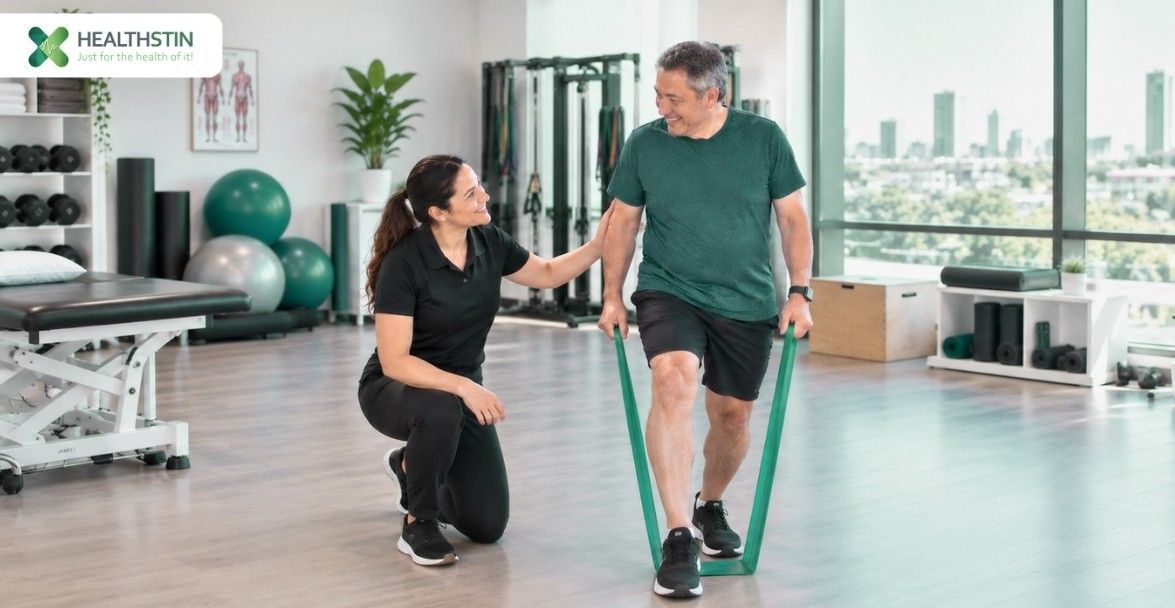
Why Are More Perth Residents Choosing Community-Based Exercise Physiology?
Getting to a clinic is not always the hard part of therapy. Sometimes it is the entire barrier.
- Home visits remove the transport problem. If driving is difficult, or arranging a lift eats the whole morning, home-based sessions take that obstacle out of the equation.
- Real-world rehabilitation. Practising stairs on your own stairs and transfers on your own bed works better than practising them on clinic equipment.
- Flexible delivery. Sessions at home, out in your local community, or via telehealth for reviews and check-ins between visits.
- Better follow-through. Programmes people can fit into an ordinary week tend to get done. Programmes that require a 40-minute drive each way tend not to.
- Less travel across a spread-out city. Perth is large and low-density. For someone in the outer suburbs, a home visit can be the difference between weekly therapy and none.
There is a trade-off worth naming. A clinic gives you access to full gym equipment and a Hydrotherapy pool, and community-based work does not. What it gives you instead is a programme built with the equipment you actually have, in the space you actually use, which is usually what determines whether you keep doing it. Where loaded gym work or pool-based rehabilitation is clearly the better option, your AEP should say so and help you find it.
What Should You Look for When Choosing an Exercise Physiologist in Perth?
ESSA accreditation
Check it rather than assume it. ESSA maintains a public directory, and it is a fair question to ask directly. Also ask whether the person actually seeing you is an AEP or an exercise scientist, because they are not the same qualification.
Relevant clinical experience
Ask how often they work with your condition. Someone who sees Parkinson’s disease weekly will prescribe differently to someone who has seen it twice.
Multidisciplinary support
Can they speak to your physiotherapist? Is there one in the same organisation? Shared notes and a documented trigger for reviewing a programme when your function changes are what turn several clinicians into coordinated care.
Funding knowledge
Ask plainly: do you work with plan-managed and self-managed NDIS participants, DVA D904 referrals, Support at Home, and Workers’ compensation? Ask whether travel time for home visits is charged to your plan, because practices differ, and it affects how far your funding goes.
Personalised treatment planning
A programme handed to you on day one, before any assessment, is a template. Yours should change after the first few sessions, because that is when your AEP learns how you actually respond.
Comparing Exercise Physiologist Perth options at a glance
| What to Ask | Why It Matters |
| Are you ESSA accredited as an AEP? | Determines funding eligibility and clinical scope |
| How often do you see my condition? | Familiarity changes how a programme is built and progressed |
| Can you see me at home or by telehealth? | Access is the main reason programmes stop |
| Which funding streams do you work with? | Avoids paperwork delays and unexpected invoices |
| Is travel time charged to my plan? | Affects how many sessions your budget covers |
| How will progress be measured and reported? | Gives your plan review or GP something concrete |
Why Choose Healthstin Exercise Physiology in Perth?
Healthstin is a multidisciplinary allied health provider working across exercise physiology, physiotherapy, Hydrotherapy and remedial massage. Our Exercise Physiology Perth service is delivered as mobile appointments from our Belmont base. We come to you at home or in your local community, with telehealth available for reviews. There is no in-clinic option in Perth at present.
What that means in practice:
- Accredited Exercise Physiologists working to ESSA standards
- Mobile in-home appointments across the surrounding Perth suburbs
- Local community visits where a park, a footpath or a set of stairs is the right setting for the goal
- Telehealth appointments for reviews and programme check-ins
- No travel to a clinic and no waiting room
- NDIS, Support at Home, DVA, Workers’ compensation and privately funded clients
- Physiotherapy and remedial massage colleagues in the same organisation
- Goal-focused programmes reviewed and adjusted as your needs change
We will also be straight with you about the less tidy parts. Perth is currently mobile-only, so if you specifically want gym or Hydrotherapy pool sessions, we are not the right fit for that part of your programme and will let you know. Funding paperwork takes time. Plan reviews come around regardless of whether you have had a good few months. Progress with a long-term condition is rarely a straight line, and anyone promising otherwise is overselling, knowing that up front tends to be more useful than finding out in month three.
FAQs About Accredited Exercise Physiologists (AEPs) in Perth
1. What does an Accredited Exercise Physiologist do?
An AEP assesses your movement, strength and health history, then prescribes exercise as a treatment for injury, disability or chronic conditions. They also monitor how you respond, adjust the programme, and report back to your GP, plan manager or referrer where that is part of your funding.
2. Do I need a referral to see an Exercise Physiologist?
Not for private or NDIS-funded services. You can contact a provider directly. You do need a referral for Medicare-subsidised sessions under a GP Chronic Condition Management Plan, and for DVA-funded sessions, which use a D904 referral form from your GP.
3. Can the NDIS fund Exercise Physiology services?
Yes, where it relates to your disability and supports the goals in your plan. Funding usually comes from the Capacity Building budget. Whether a particular service is approved depends on your individual plan, so check with your planner, support coordinator or plan manager rather than assuming.
4. Is Exercise Physiology suitable for older adults?
It is one of the main groups AEPs work with. Strength and balance programmes have good evidence for reducing falls, and exercise physiology is funded as allied health under the Support at Home programme when it forms part of an assessed care plan.
5. What’s the difference between an Exercise Physiologist and a Physiotherapist?
Physiotherapists commonly focus on assessing and treating injury and movement problems, often including hands-on treatment. Exercise physiologists use structured exercise to manage chronic conditions and rebuild function over a longer period. Plenty of people see both, and the two disciplines work well together when they share notes.
6. How often should I see an Exercise Physiologist?
It depends on your condition, your goals and your funding. Many people start weekly or fortnightly while the programme is being established, then move to monthly reviews once they are managing independently. Your AEP should explain the reasoning and revisit it as you progress.
Take the First Step Towards Better Health, Mobility and Independence
Most people come to us wanting one of three things: to move with less pain, to stop relying on someone else for everyday tasks, or to feel steady enough on their feet to stop worrying about a fall. Those are reasonable places to start.
You can book an assessment online at a time that suits you. Your first session is an assessment rather than a workout, and you will leave with a programme built around your goals, your funding and what you can safely do right now, not a generic plan with your name on the top.
If you would rather talk it through first, a free 10-minute consultation is enough to work out whether we are the right fit. GPs, support coordinators and care managers can send a referral directly.
Call 1300 090 931 or contact the Perth team to get started.
Disclaimer: This article provides general information and is not a replacement for personal medical or clinical advice. Exercise carries some risks, and what works for one person might not work for another. Talk to your GP, Accredited Exercise Physiologist, or health professional before starting a new programme, especially if you have a heart condition, high blood pressure, diabetes, a recent injury or surgery, or serious balance issues. Rules for accreditation and funding can change. Check the latest information with Exercise & Sports Science Australia, the NDIS, My Aged Care, the Department of Veterans’ Affairs, or Services Australia.