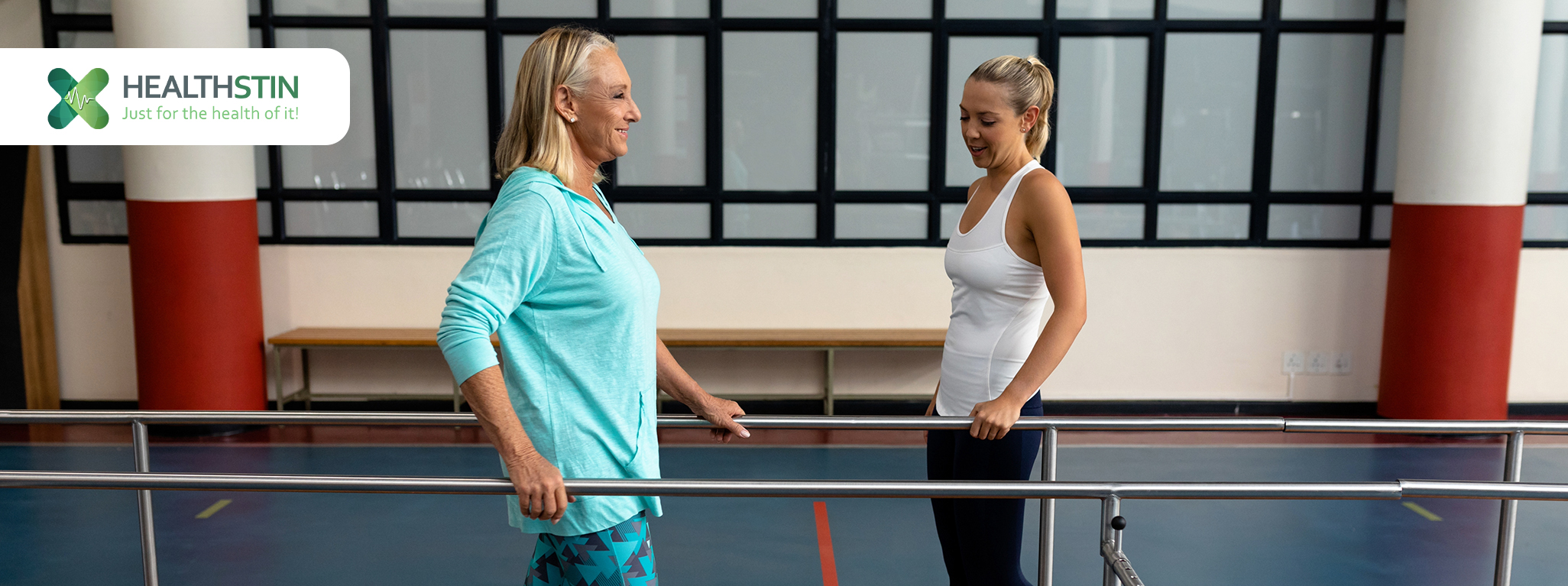
Why are neuro physio exercises for balance and stability exercises important?
When someone has a neurological condition—like a stroke, MS, or Parkinson’s—it can mess with the way the brain talks to the body. This often makes it hard to stay steady on your feet or move smoothly, which increases the risk of falling and makes it tougher to get around.
Neurological physiotherapy uses special balance exercises to fix these “communication” issues. Think of it like a retraining program: these exercises teach your brain and muscles how to work together as a team again, helping you feel more stable, confident, and independent in your daily life.
These exercises are intended to:
- Improve gait and posture
- Enhance the body’s sense of spatial orientation
- Strengthen core muscles
- Boost your confidence with your movement
Key neuro physio exercises for balance and stability
Here are a few great exercises suggested by neurological specialists. Before you give them a try, make sure to chat with a local neuro physio. Everyone’s body is different, and a professional can tweak these moves to make sure they are safe and actually work for your specific needs.
| Exercise | Objective/Purpose | How to perform it |
| Single Leg Stance | Enhances lower limb strength and balance. Neuro physio professionals in Melbourne, Sydney, as well as across Australia often incorporate this into rehabilitation plans. | • Stand next to a sturdy surface, like a wall or chair, for support. • Lift one foot off the ground and balance on the standing leg. • Hold the position for 10-30 seconds, then switch sides. Once you become comfortable with performing the movement, try closing your eyes or holding the position without support. |
| Tandem Walking | Improves coordination and gait stability. This exercise is commonly recommended to simulate real-life walking challenges. | • Walk forward in a straight line, placing one foot directly in front of the other. • Keep your arms out for balance. • Practice for 2-3 minutes daily. |
| Heel-to-Toe Rocking | Strengthens ankle muscles and enhances balance control. Frequently recommended to patients with peripheral neuropathy. | • Stand with your feet shoulder-width apart. • Rock forward onto your toes, lifting your heels. • Then rock backward onto your heels, lifting your toes. • Repeat 10-15 times. |
| Seated Marching | Improves coordination and strengthens hip flexors. This low-impact exercise is ideal for individuals with severe mobility limitations. | • Sit on a sturdy chair with your feet flat on the floor. • Lift one knee towards your chest, then lower it back down. • Alternate legs in a marching motion for 1-2 minutes. |
| SideStepping | Enhances lateral stability and balance. Neuro physio in Sydney, Adelaide, and all over Australia often use this as part of dynamic balance training. | • Stand upright with your feet together. • Take a step to the side, then bring the other foot to meet it. • Repeat for 1-2 minutes in each direction. |
| Balance Board Training | Improves dynamic balance and coordination. This exercise is widely utilised for patients with vestibular disorders. | • Stand on a balance or wobble board. • Shift your weight in all directions to keep the board steady. • Practice for 2-3 minutes, gradually increasing the duration as you gain confidence. |
| Bridging Exercise | Strengthens the core and lower back, improving overall stability. | • Lie on your back with your knees bent and feet flat on the floor. • Lift your hips off the ground until your body forms a straight line from the shoulders to your knees. • Hold for 5-10 seconds, then lower back down. • Perform 10-12 repetitions. |
Important Note:The information is general and does not take into account your personal situation. This information is intended to show you the correct exercise technique and should not be used to self-diagnose or self-treat any medical condition. If your pain persists or you have difficulty exercising, please see your experienced Exercise Physiologist or Physiotherapist for proper guidance via 1300 090 931.
Complementary therapies to enhance balance and stability
Whilst these exercises form the foundation of neuro physio programmes, incorporating additional therapies can help accelerate recovery:
| Hydrotherapy
|
Doing exercises in water reduces joint strain whilst improving strength and balance. |
| Assistive
Devices |
Tools like walking poles or balance trainers can provide extra support during recovery. |
| Mindfulness
Training |
Practices like yoga and Tai Chi improve focus, balance, and coordination. |
Tips for safe and effective training
- Talk to a professional first: Check in with a neuro-physio before trying any new moves.
- Start slow: Begin with easy movements and only make them harder once you feel ready.
- Clear your space: Make sure your workout area is safe and free of anything you could trip over.
- Stick with it: You’ll see the best results if you practice regularly. Consistency is key!
For anyone recovering from a brain or nerve-related injury, special balance and stability exercises are a game-changer. By practicing specific moves—like standing on one leg, walking heel-to-toe in a straight line, or using a wobble board—you can rebuild your confidence and get back to enjoying life.
Just remember to work with a professional first; they’ll help you create a plan that is safe and actually works for you.
Get professional neuro physio services at Healthstin
If you’re searching online for “neuro physio near me,” you’ll most likely find one of Healthstin’s clinic locations in the search results and with good reason. At Healthstin, our well-experienced and accredited Allied Health Professionals are committed to creating tailored exercise programmes including those that address your need for better balance and stability through neuro physio exercises.
As an accredited CHSP provider, we are committed to serving key areas including the South East Sydney and Adelaide Metro North through in-clinic and mobile home visits.
Learn more or book an appointment by calling 1300 090 931 or clicking this link.