When “David” (name changed for anonymity) gets upset or excited, he kneads his hand and twists in his seat. Or sometimes, he looks out the window and grumbles. “This thing is a ticking time bomb–a hijacker,” he shares with his physiologist. “The doctors told me to push myself, but they didn’t tell me how to stop blood spikes.” David, a former tradesman, finds life with a T4 injury to be like crossing a tightrope.
An issue that gets him riled up often is the hidden risk of Autonomic Dysreflexia (AD). And with good reason—spinal cord injury rehabs come with the complexities of navigating the autonomic nervous system, where the line between a successful workout and medical emergency is thin, almost indistinguishable.
In the broader health landscape, poor and inadequate chronic care management remains a leading cause of hospital re-admissions. Nearly every SCI patient will tell you that a sudden spike in blood pressure during a day at the gym can quickly put them in the ER.
The operating mantra at our Salisbury clinic is to keep our clients safe, which doesn’t mean staying still. Rehab safety for SCI patients is to help them perform prescribed workouts without putting their cardiovascular system at risk.
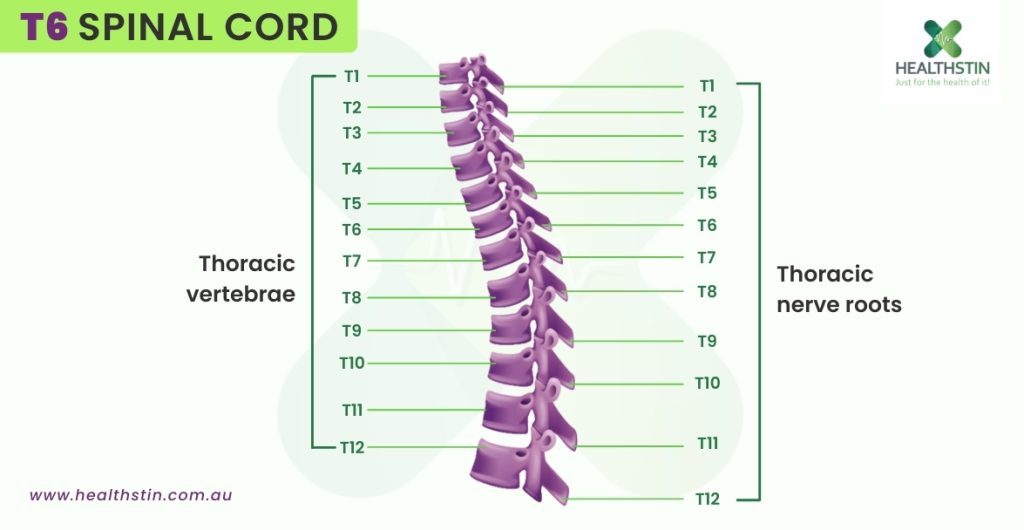
The Risk of Autonomic Dysreflexia: Why “Standard” Exercise Isn’t Enough
Autonomic Dysreflexia (AD) is a medical emergency that affects individuals with SPI, specifically those injured at or above the T6 level. It is an uncontrolled, quick spike in blood pressure triggered by a stimulus below the level of injury—something as simple as a full bladder, a tight waistband, or an ingrown toenail.
In a standard gym environment, AD is a “silent killer. During an intensive workout, the heart rate races faster. For someone undergoing SCI, the same symptoms, along with blurred vision, sweating above the level of injury and a pounding headache, are red flags of a hypertensive crisis.
Why the “Silent” Threat is Dangerous
In an exercise setting, AD is often mistaken for the normal physiological response to a hard workout. An experienced exercise physiologist can determine whether the patient is exhibiting usual sweat profusion or already experiencing a blood pressure spike.
Without spinal cord injury rehab protocols in place, there will be a heightened risk of cardiac arrest, seizure, or stroke. This is why SPI patients are discouraged from working out at standard community gyms. They need the guidance of exercise physiologists who can focus on their specific needs.
How Our Salisbury Exercise Physiologists Monitor Your Vitals During Rehab
At our Salisbury clinic, no rehab workouts will proceed without blood pressure management protocols in place. Our Exercise Physiologists (EPs) look beyond workouts and identify outliers in physiological data.
The Protocol for BP Monitoring
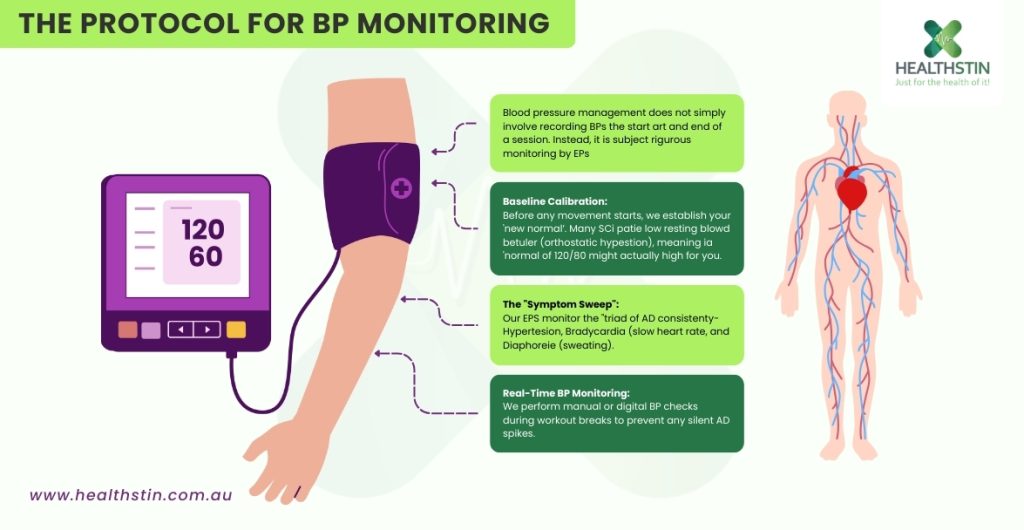
Blood pressure management does not simply involve recording BPs at the start and end of a session. Instead, it is subject to rigorous monitoring by EPs.
Baseline Calibration: Before any movement starts, we establish your “new normal.” Many SCI patients have low resting blood pressure (orthostatic hypotension), meaning a “normal” reading of 120/80 might actually be high for you.
Real-Time BP Monitoring: We perform manual or digital BP checks during workout breaks to prevent any silent AD spikes.
The “Symptom Sweep”: Our EPs monitor the “triad of AD consistently”-Hypertension, Bradycardia (slow heart rate), and Diaphoresis (sweating).
Beyond the Cuff: Holistic Vigilance
Managing the environment and personnel is key to successful, safe spinal cord injury rehabilitation. If we detect a sudden spike in BP, we drop everything and immediately perform search and eliminate protocols that involve the following:
A clinical nurse will check if your catheter isn’t twisted and that your bladder isn’t overfull.
A nurse will assess whether something is pinching or pressing into your skin, such as a tight waistband, a shoe that curls your toes, pressure on the sides of your foot, or red marks from sitting too long in one position.
We check whether your bowels are full or if anything is painful, such as an ingrown toenail, a scratch, or a hidden bruise.
By integrating these protocols into the exercise environment, you will be assured of your safety and confidently push your limits further.
Achieving Independence: Safely Bridging the Gap Between Hospital and Home
Acclimation to community-based physiotherapy services is key to progress and rehabilitation. Our clinic–physio Salisbury services–serves as a middle ground between a hospital (where doctors and nurses assist you at all times) and your home (where you are often on your own). As a physio clinic, we focus on translating clinical gains into functional independence. For us, success is not just stronger biceps capable of heavier curls, but the ability to perform Activities of Daily Living (ADLs).
Functional Goals We Target:
Car Transfers: Safely moving from a wheelchair to a vehicle seat.
Upper Limb Power: Building the necessary and optimal strength needed to travel on uneven footpaths.
Core Stability: Utilising what innervation remains to improve sitting balance, which is crucial for independent dressing.
Finding Your New Centre of Gravity: We work on strengthening every muscle still connected to your brain. For example, training your trunk and back muscles will help you to sit upright with support. In other words, you must maintain your independence, including the ability to dress yourself.
Therefore, the goal of rehab is not just to walk again–but it’s to live again. Safety and moving without the anxiety of AD is the foundation of that freedom.
3 Ways We Ensure a Safe SCI Training Environment
There’s always fear and hesitation when it comes to SCI rehab. The “what-ifs” can hold you back. To address this, our Salisbury facility is committed to the three safety pillars.
-
Equipment & Accessibility
Standard gym equipment is often unsafe for people with weak or no trunk stability. Instead, our clinic utilises:
Ceiling Hoists and Body-Weight Support Systems: For standing and gaining exercises without fall risks.
Wheelchair-Integrated Resistance Machines: Train without risking transferring out of your wheelchair if you are not ready.
-
Evidence-Based Clinical Guidelines
Our protocols are science-based, not guesswork. Everything we do is grounded in peer-reviewed research and organisations such as the Academy of Spinal Cord Injury Professionals (ASCIP).
| Feature | Standard Gym | Our Salisbury SCI Rehab |
| Staff Training | General Cert IV | University-qualified Exercise Physiologists |
| BP Monitoring | None/Rare | Continuous & Event-Based |
| AD Response Plan | Call 000 | Immediate Clinical Intervention + Emergency Protocol |
| Goal Focus | Aesthetics/General Health | Functional Independence & ADLs |
-
Collaboration with Your Medical Team
We ensure that we are on the same page as you, your GP and your neurologist by maintaining open lines of communication. This multidisciplinary approach ensures that your rehab plan aligns with your latest scans, medication changes (such as Baclofen for spasticity), and surgical outcomes.
Resources for Patients and Clinicians
For a deeper dive into the clinical side of SCI management, active rehab, and neuroplasticity (the medical term that shows that the nervous system is still capable of change even after a spinal injury), we recommend the following resources:
SCIRE Project (Spinal Cord Injury Research Evidence): A comprehensive resource for world-class, peer-reviewed articles on SCI rehabilitation.
The World Health Organization (WHO) Fact Sheets: For global statistics and standards on SCI care.
ANZSCoS (Australia and New Zealand Spinal Cord Society): The leading professional body for SCI clinicians in our region.
The Path Forward: From Fear to Fortitude
You may be tired of being told to “be careful” all the time when you want to push yourself instead. You may be tired of looking at your loved ones worried about you every time you transfer from your wheelchair. And because of their uneasiness about your condition, you remain inactive and prefer to stay safe.
Don’t let the tail wag the dog. It’s time for a different approach. Take control.
Spinal cord injury rehab is not about playing safe; you stagnate because of it. It is about managing risks. The best way to do this is to have a team of professionals who know which exercises you need and how to monitor your blood pressure. Focus on doing hard work to rebuild your life!
We know how to help you push your limits—and we know how to do it safely.

Start Your Journey Safely: Book an SCI Clinical Assessment in Salisbury
The most paralysing issue about Autonomic Dysreflexia is the fear of it–the fear that it will strike you suddenly. But what if you have a team that can protect you from these spikes? Will you move forward? You can. And you should. Our accredited team of EPs can help you navigate the complexities of SCI recovery using a science-based approach.
In your 60-minute Clinical Assessment, we will:
- Perform a comprehensive review of your injury level and medical history.
- Establish your baseline cardiovascular “norms” to ensure safe training.
- Discuss your specific independence goals (Transfers, ADLs, Wheelchair Skills).
- Create a structured roadmap for your community-based rehab.
Healthstin provides exercise physiology services across multiple states in Australia.
- Sans Souci, NSW – Supporting southern Sydney residents
- Hurstville, New South Wales (NSW) – Conveniently located for serving the St George community
- Salisbury & Elizabeth, South Australia (SA) – Accessible for Adelaide’s northern suburbs
- Brimbank & Melton, Victoria (VIC) – Supporting communities in Melbourne’s west
- Belmont, Western Australia (WA) – Expanding to meet growing local demand
Our team can deliver therapy in our clinics, in your home, or within the community.
Know Someone Who Could Benefit from Our Services?
At Healthstin, we’re here to support every step of your rehab and wellness journey—from personalised physiotherapy and exercise physiology to ongoing NDIS support tailored to your needs. If you know a friend, client, or loved one who could use professional care, simply complete our quick Referral Form
Refer Someone Today and help them start their path to better health and independence.
FAQ about Spinal Cord Injury Rehab
-
How can I fund my spinal cord injury rehab sessions at your Salisbury clinic?
To overcome the financial challenges of long-term recovery, our rehab programs can be funded through several insurance pathways.
- NDIS (National Disability Insurance Scheme): Most of our clients are covered through Capacity Building – Improved Health and Wellbeing or Improved Daily Living. We accept Self-Managed and Plan-Managed participants.
- WorkCover (ReturnToWorkSA): Injuries that happened in the workplace or during a commute is covered under this program. We will work directly with your case manager to ensure you receive the necessary rehabilitation.
- DVA (Department of Veterans’ Affairs): Gold and White cardholders may be eligible for Exercise Physiology services with a GP referral (D904 form).
-
What is the difference between a Physio and an Exercise Physiologist for SCI?
Both are vital in your SCI recovery. Physiologists manage acute conditions, including temporary pain, joint mobility, and respiratory health. An Exercise Physiologist employs the mantra of
‘exercise as medicine’, such as cardiovascular conditioning, high-intensity functional workouts, and long-term management of secondary conditions like AD. EPs and Physios may overlap in their roles. For clients seeking the best results, we recommend leveraging our collaborative approach.
-
I was recently discharged from the Royal Adelaide Hospital. How soon can I start?
Transitioning from hospital to home is a difficult adjustment phase for SPI patients. Once you receive medical clearance from your specialist or GP, we recommend starting your spinal cord injury rehab at a community-based clinic. During this phase, typically within the first two weeks, we conduct an initial assessment of your condition to ensure your program is safe and your blood pressure is stable.
-
Is it safe to push myself if I am at risk of Autonomic Dysreflexia?
Yes, but only under clinical supervision. Pushing your limits safely means we monitor your blood pressure in real time and identify your ceiling. Then we gradually increase the intensity of your activity while monitoring your vital signs. By doing this, your body adapts without triggering a hypertensive state. Our team of professionals are trained to spot the silent symptoms of AD that gym trainers might overlook.
-
Can you help me with specific activities of daily living (ADLs), like car transfers and changing clothes?
Absolutely. We have equipped our Salisbury facility to run programs that mimic real-world challenges. The clinic does not depend on weighted plates and kettlebells. We have designed specific activities and movement patterns to help you pivot your weight, lock a wheelchair, or safely transfer from your wheelchair to a car or bed.
-
What should I bring to my first SCI assessment?
To provide the safest care, please bring:
- Your latest discharge summary from the hospital or other rehab centre.
- A list of medications you’re currently taking (particularly blood pressure or anti-spasticity meds like Baclofen).
- Your NDIS plan or claim number (for WorkCover/DVA).
- Wear loose clothing so we can easily place a blood pressure cuff on your upper arm.
-
Do I need a referral to book an appointment?
NDIS self-managed programs do not need a formal referral to begin. However, a case manager from the insurer (Return to Work SA, DVA, or Medicare) confirms they are covered to start Exercise physiology or physiotherapy programs.
Spinal Cord Injury Clinical Assessment in Salisbury
At our Salisbury clinic, we provide evidence-based care to support your functional goals and long-term wellbeing. Our NDIS-approved Exercise Physiology and Physiotherapy programs are tailored to your specific injury level, focusing on transfer safety and physiological management.
- Accessible Care: Start your rehabilitation promptly at our fully equipped clinic.
- Transparent Value: Benefit from comprehensive clinical oversight with no hidden administrative fees.
- Full Coordination: We manage NDIS, WorkCover, and DVA documentation for you.