According to recent surveys, some 4 million Australians go to the gym, making this the nation’s second most popular sporting activity, next only to walking. While this comes as good news, it turns out that in general, Australians’ levels of physical activity remain low. In all age groups, studies report that most Australians are not meeting the minimum guidelines for exercise and physical activity to achieve optimum health. Among adults, only one-fourth of the population are meeting the minimum guidelines while more than two-thirds is not doing strength-based activities.
For adults aged 18 to 64 years old, this means performing 2 ½ to 5 hours of moderate-intensity exercise weekly or 1 ¼ to 2 ½ hours of vigorous exercise weekly. This involves training for cardiovascular fitness, strength, and flexibility. The lack of access to gym facilities, entry fees, travel costs, and discomfort or lack of confidence in exercising in public are some of the most cited barriers to regular exercise.
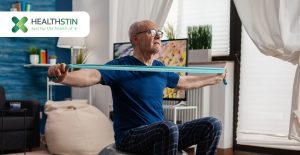
One way to get around these barriers is to train at home. In recent years, exercise bands, also known as resistance bands or physio stretch bands, have gained popularity as versatile tools for home workouts. These thick elastic bands are made from rubber or similar material that allows you to perform exercises that can strengthen your muscles. Whether you’re aiming to build strength, improve flexibility, or simply stay active, exercise bands offer an inexpensive, convenient, and effective solution. We explore the best exercises you can do with resistance bands at home, highlighting their benefits and providing practical tips for incorporating them into your fitness routine.

Why Use Exercise Bands at Home?
Exercise bands have gained popularity for use in home workouts for many reasons which include several key advantages:
- Affordable and accessible — Exercise bands are inexpensive and readily available, making them accessible for almost anyone looking to start a home fitness regimen.
- Portable — They are lightweight and easy to store, making them ideal for small spaces or travel.
- Versatile — From light resistance for beginners to heavy resistance for seasoned athletes, exercise bands can be used to target various muscle groups effectively. Resistance bands can also be used by exercisers of all ages from children to older adults.
- Great for flexibility – You can use your resistance bands for warm-ups and to help stretch your muscles prior to your main workout.
- Allows your muscles to work harder – Training with free weights, muscle tension is concentrated in the concentric portion of the movement when your muscles contract. When doing a squat with a barbell, that means focusing on getting up to the standing position using your quadriceps.
On the other hand, training with resistance bands allows your muscles to work through a fuller range of motion, through both the concentric and eccentric portions of the movement. For the squat exercise, that means working your legs when both standing up and squatting/lowering your upper body.
- Joint-friendly for older adults – Resistance bands offer a gentler kind of tension that is more friendly to your joints than free weights. This is especially beneficial for older adults who experience joint stiffness or discomfort.
- May help in balance training – You can use resistance bands to train your core and lower body which can enhance your stability and balance.
- Safety – Using resistance bands to train at home means doing away with heavy weights that may drop on your foot or free weights that may overextend your joints.
Getting Started: Types of Exercise Bands
Before diving into exercises, it’s essential to understand the types of exercise bands that are available:
- Loop bands – These are continuous loops of varying resistance levels, used primarily for lower body exercises like squats and leg lifts.
- Tube bands with handles — Flexible bands with handles at each end, these are suitable for both upper and lower body workouts such as bicep curls and chest presses.
- Figure-Eight bands — Shaped like a figure-eight or the infinity symbol, these bands are great for upper body exercises and can simulate movements like rowing or chest flies.
When selecting bands, you should take your fitness level and the muscle groups you want to target into consideration. Start with lighter resistance bands if you’re a beginner and gradually move up in resistance as you get stronger.
How to use resistance bands at home
Using resistance bands effectively involves a few key steps to ensure safety and maximise effectiveness:
- Have a safe setup at home — Choose a clear, spacious area where you can move freely without obstructions to avoid slipping, falling, bumping into furniture, or injuring yourself.
- Anchor your bands securely – Always make sure to secure the band no matter what exercise you perform. This could mean wrapping it around your feet, anchoring it to a door frame using a door anchor, or using a sturdy piece of furniture.
- Observe proper posture and form – Remember to maintain proper posture throughout each exercise to prevent injury and achieve optimal muscle engagement. Focus on controlled movements and avoid jerking or snapping the band.
What are some of the best resistance band exercises?
Here, we explore the ideal exercises to perform using resistance bands, targeting your upper and lower body as well as your core:
Upper Body Exercises
- Banded push-ups — Place the band across your upper back and hold the ends in each hand, adding resistance to standard push-ups. Muscles targeted: chest, shoulders, and triceps.
- Bent-over rows — Step on the band with one foot and hinge forward at the hips, pulling the band toward your waist. Muscles targeted: upper back and biceps.
- Shoulder presses — Stand on the band with both feet and hold the handles at shoulder height, pressing upwards. Muscles targeted: shoulders, triceps.
- Standing chest press — Step on the band with one foot, holding the handles at shoulder height and pressing forward. Muscles targeted: chest, shoulders, and core muscles.
Lower Body Exercises
- Squats — Position the band above your knees or under your feet, squatting down while maintaining tension on the band. Muscles targeted: glutes, quads, and hamstrings.
- Lateral band walks — Place the band around your thighs and step sideways against the resistance to improve your hip stability. Muscles targeted: hip abductors
- Glute bridges — Lie on your back with the band just above your knees, lifting your hips off the ground while squeezing your glutes for an effective lower body workout. Muscles targeted: gluteus maximus, hamstrings, core
Core Exercises
- Twists — Sit on the floor with legs extended or bent, holding the band with both hands and rotating your torso side to side to improve your rotational strength. Muscles targeted: obliques
- Plank with band rows — Start in a plank position with the band anchored under your hands, alternating rows while maintaining a stable core. Muscles targeted: upper body and core muscles
- Woodchoppers — Anchor the band overhead or at a low point, pulling diagonally across your body in a chopping motion to improve your rotational strength. Muscles targeted: core
To incorporate these exercises into a cohesive workout routine, remember to do these steps:
- Warm up — Start with 5-10 minutes of dynamic stretches or light cardio to prepare your muscles for exercise.
- Ease into your main workout — Select 6-8 exercises from the list, performing 2-3 sets of 10-15 repetitions for each exercise.
- Cool down — Finish with static stretches focusing on major muscle groups to improve flexibility and reduce muscle soreness.
Exercise bands offer a versatile and accessible option for home workouts, catering to individuals of all fitness levels. Whether you’re targeting specific muscle groups or aiming for a full-body workout, incorporating resistance bands can enhance your strength, flexibility, and overall fitness.
Start slowly with light resistance and make adjustments as you progress and get stronger. With consistency and proper technique, you can achieve your fitness goals in the comfort of your home.
Need guidance or motivation to train at home?
If you need guidance on how to start your exercise routine, feel free to consult our Exercise Physiologists at Healthstin today by calling 1300 090 931 or clicking this link. Our well-trained and experienced Allied Health Professionals are always ready to support you on your health and fitness journey whether at the gym or home, the latter option available through mobile visits.
Important Note: The information presented above is general in nature and does not take your personal condition or situation into consideration. It is intended to show the correct exercise technique and should not be used to self-diagnose or self-treat any medical condition. If your pain persists or you experience difficulty in performing an exercise, see your experienced Exercise Physiologist for guidance.