It can be tough to build upper-body strength at home, especially if you do not have a gym or heavy equipment. Many people find weights intimidating, costly, or hard to use in small spaces. Some workouts also put a lot of pressure on the joints, which can make it difficult for beginners, older adults, or those recovering from injuries to keep up.
This is why resistance band exercises for the upper body are now a popular choice for home workouts and rehab. Resistance bands are affordable, easy to carry, and work for any fitness level. They help you tone muscles and improve mobility and flexibility, making it easier to strengthen your shoulders, chest, back, and arms without putting too much strain on your body.
Why Use Resistance Bands for Upper Body Training?
A lot of people think you need heavy weights or a gym membership to build upper body strength, but that is not always true. Resistance bands are a practical choice for anyone looking for a flexible and beginner-friendly way to work out. You can use them almost anywhere, and they can be adjusted to fit different strength levels and fitness goals.
A big advantage of resistance band workouts for the upper body is how flexible they are. You can use them to tone your muscles, improve your movement, and do gentle resistance training that does not put stress on your joints. This makes them a good option for beginners, older adults, or anyone recovering from an injury who still wants to get stronger and move better.
Muscles Worked in Upper Body Band Exercises
Resistance band exercises for the upper body are effective because they work several muscles at once. They can help improve posture, build strength and stability, and support both fitness and rehab goals. These exercises are also gentle on the joints and great for beginners.
| Muscle Group | How Resistance Bands Help |
| Shoulders | Shoulder presses and lateral raises can strengthen, stabilise, and increase the flexibility of your shoulders. |
| Chest | Chest presses and band flies help build chest strength and make pushing movements easier. |
| Back | Rows and pull-aparts work the upper back, which can improve your posture and help relieve tightness from sitting too much. |
| Arms | Bicep curls and tricep extensions make your arms stronger and help your muscles look more defined. |
| Core Support | Many resistance band exercises also work your core, which helps you stay balanced, stable, and maintain overall functional strength. |
7 Best Resistance Band Upper Body Exercises
You can use resistance bands to get stronger at home without heavy equipment. A simple upper-body workout helps you work several muscles whilst keeping your movements steady and gentle on your joints.
1. Resistance Band Chest Press
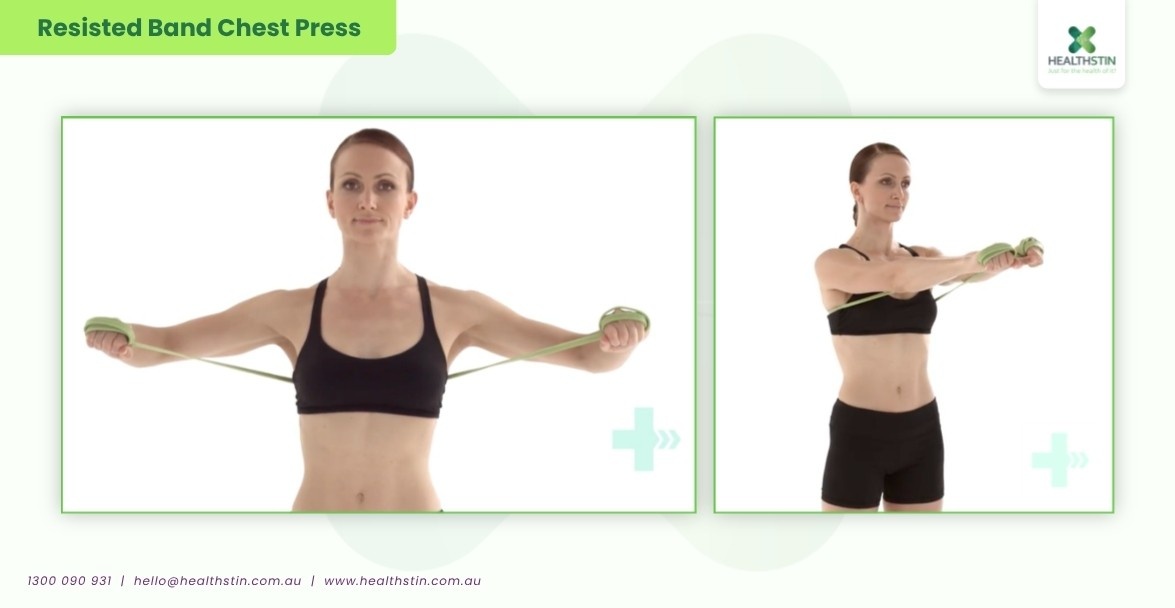
The resistance band chest press is a great band exercise for your arms and shoulders, especially if you are new to strength training at home. It helps you build pushing strength without putting much stress on your joints, making it well-suited for both fitness and recovery.
Instructions:
- Stand or sit upright with your back tall.
- Loop a resistance band behind your back and under your arms.
- Hold one end of the band in each hand.
- Start with your elbows bent and your hands near your chest, keeping a little tension in the band.
- Slowly push both arms straight forward until they are fully extended in front of you.
- Pause briefly at the end of the movement.
- Slowly bring your hands back to your chest with control, working against the band’s pull.
- Repeat as directed.
Helpful Tip:
Relax your shoulders and do not lock your elbows. Move slowly and with control instead of trying to go fast.
2. Seated or Standing Rows
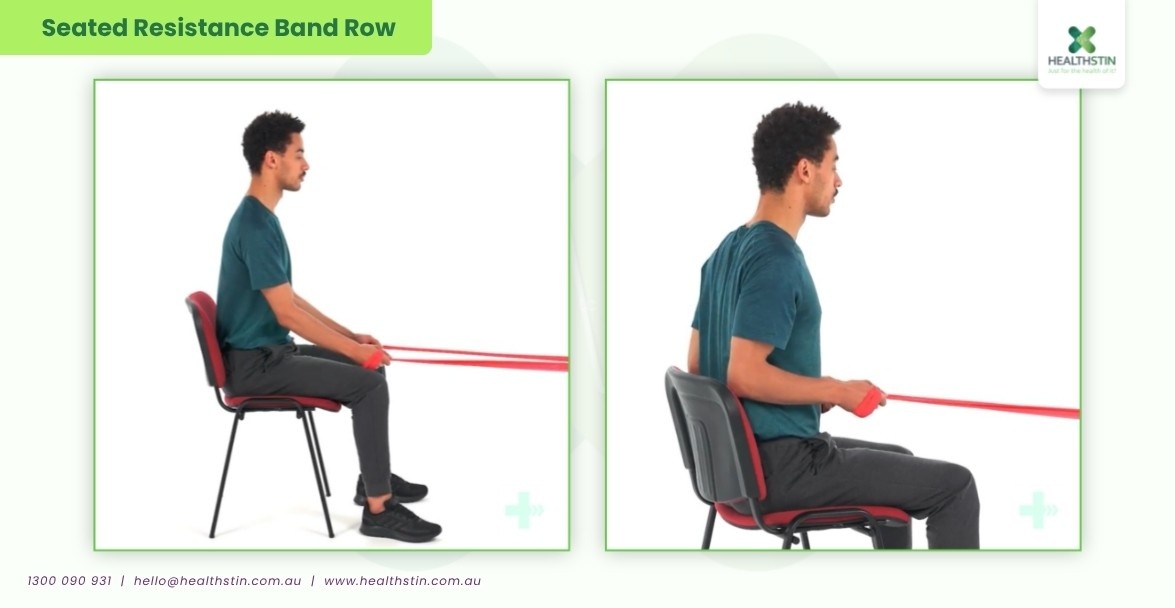
Seated or standing rows are among the best resistance band exercises for beginners who want to strengthen their upper back. They can help fix posture problems caused by sitting too much and make it easier to control your movements.
Because this routine is gentle on your joints, it is often included in both regular workouts and rehabilitation exercises. It also helps you build overall upper-body strength and control.
Instructions:
- Sit up straight on a sturdy chair, or stand tall if you like.
- Secure a resistance band to a stable object at about knee height.
- Hold one end of the band in each hand with your arms extended forward.
- Start with your elbows straight and stand or sit up tall.
- Slowly pull your elbows back, bringing your hands toward your body.
- As you row, try to squeeze your shoulder blades together.
- Pause briefly at the end of the movement.
- Slowly return your arms to the starting position with control.
- Repeat as directed.
Helpful Tip:
Try not to shrug your shoulders whilst you move. Keep your chest up and control each movement.
3. Shoulder Press
The shoulder press is a key exercise in any upper-body band workout routine. It helps strengthen your shoulders and improves arm control and stability. You can do this simple movement at home with just a resistance band.
This exercise is also great for toning muscles and is often part of low-impact resistance training programmes. It is especially helpful for beginners or anyone returning to strength training.
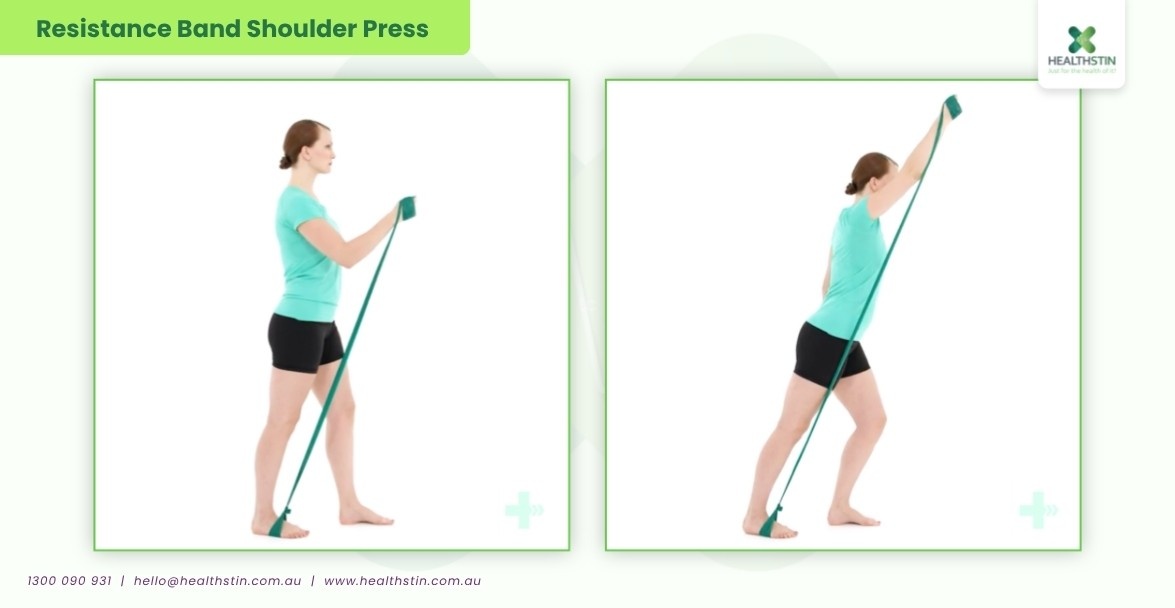
Instructions:
- Stand upright with a resistance band secured under the ball of one foot.
- Hold the other end of the band in the same hand and pull gently to create some tension.
- Step forward with your other leg, but keep most of your weight on your back leg.
- Position your hand near your shoulder with your elbow bent.
- Slowly press your hand upward toward the ceiling, straightening your elbow as you lift.
- As you press up, gently move your weight onto your front foot and reach up as far as feels comfortable.
- Slowly return to the starting position with control.
- Repeat this movement as many times as your workout suggests, then switch sides if needed.
Helpful Tip:
Keep your body straight and try not to arch your back whilst pressing. Move slowly and stay in control the whole time.
Not Sure Which Exercises Are Right for You?
If you are not sure how to start with resistance band training or need help creating a routine that feels safe and manageable, Healthstin is here for you. Our qualified exercise clinicians support people at every fitness level, from beginners and older adults to those recovering from injury.
We offer personalised exercise programmes designed to help you build strength, improve mobility, and boost your confidence, all whilst lowering your risk of injury during training.
Call 1300 090 931 to talk with our exercise team and discover the best exercise plan for you.
4. Bicep Curls
Bicep curls are an easy way to work the muscles at the front of your upper arms. Using resistance bands keeps steady tension on your muscles, which helps you build strength and control whilst being gentle on your joints.
People often include this exercise in home workouts with resistance bands. It can help you tone your muscles and build stronger, steadier arms.
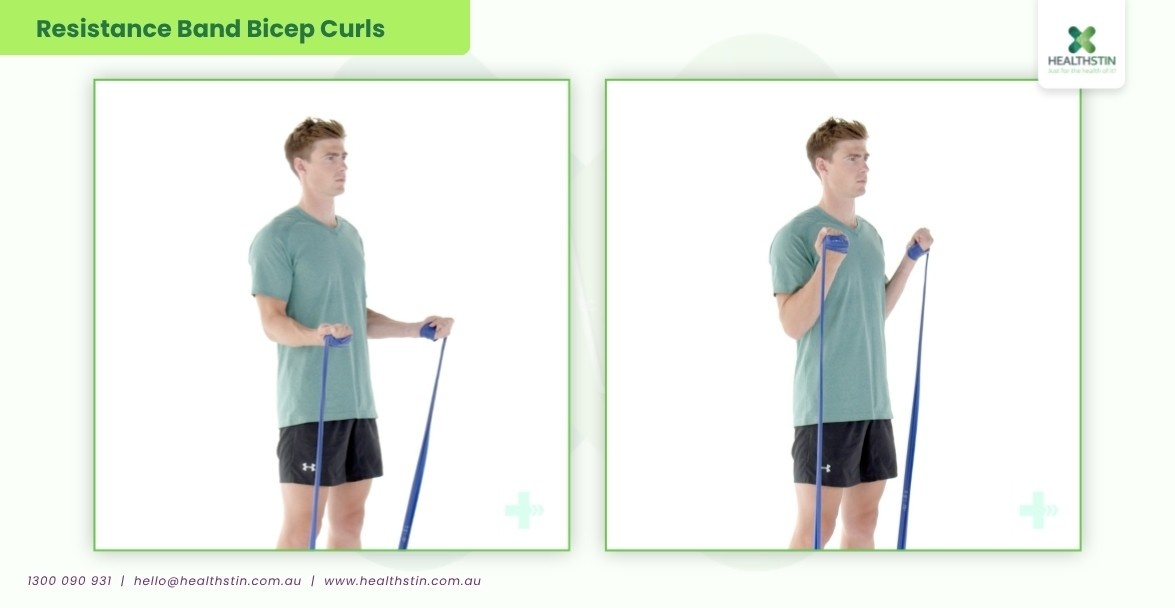
Instructions:
- Stand upright with a resistance band secured firmly under your feet.
- Hold one end of the band in each hand.
- Begin with your palms facing forward and your elbows bent at about 90 degrees. Keep light to moderate tension in the band.
- Keep your elbows close to your sides and slowly bend them more to curl your hands upward.
- Pause briefly at the top of the movement.
- Lower your hands back to the starting position slowly and with control.
- Next, rotate your palms so they face each other and repeat the curl.
- Then rotate your palms downward toward the floor and repeat once more.
- Finish the whole sequence slowly and with control, then repeat.
Helpful Tip:
Relax your shoulders and try not to swing your body as you move. Focus on making each curl smooth and controlled.
5. Tricep Extensions
Tricep extensions help strengthen the back of your arms and improve upper body stability. Using resistance bands keeps steady tension on your muscles, so they stay engaged the whole time.
This workout routine works well for people focusing on muscle toning exercises, especially if you prefer a joint-friendly option rather than lifting heavy weights.
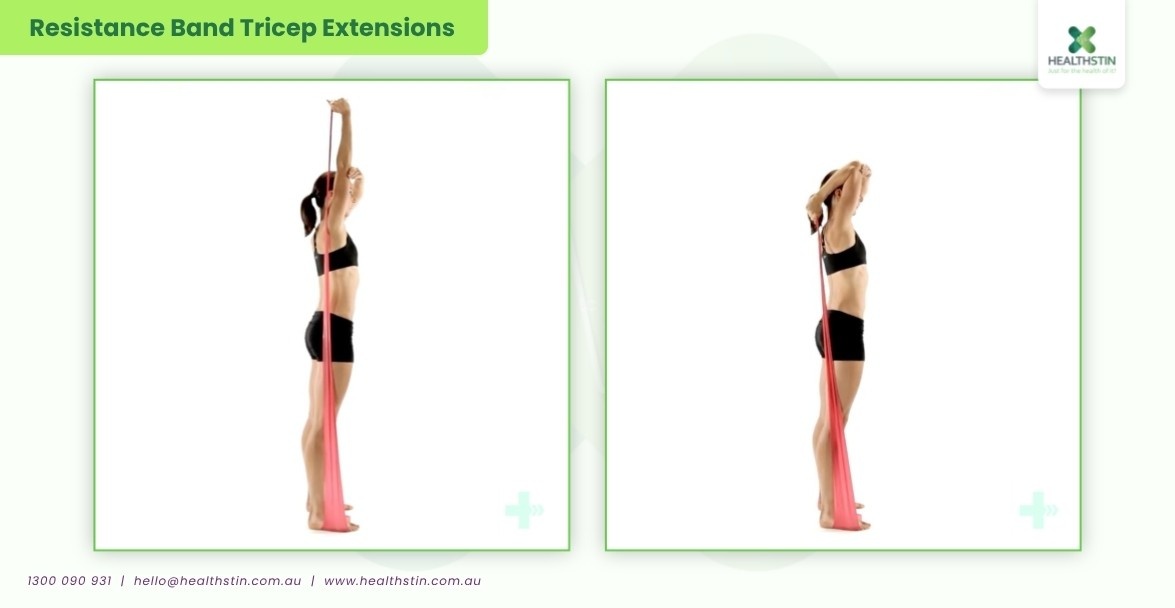
Instructions:
- Stand up straight with your feet about shoulder-width apart. Step on the resistance band to keep it in place.
- Hold one end of the band in one hand.
- Extend that arm straight overhead so your hand is above your shoulder.
- Use your other hand to gently support your working elbow and keep it close to your ear.
- Slowly bend your elbow to lower your hand behind your head.
- Keep the upper arm steady and pointed upward.
- Then straighten your elbow to press your hand back up to the starting position.
- Do the movement slowly and with control, then switch to the other side.
Helpful Tip:
Keep your elbow steady and do not let it move out to the side. Move slowly to protect your shoulder and get the most out of the exercise.
6. Lateral Raises
Lateral raises help strengthen the outer shoulders, which can improve your balance, stability, and arm control. You can easily do this exercise at home with resistance bands.
This exercise is common in beginner workouts because it encourages smooth movement and helps you build stronger, more stable shoulders over time.
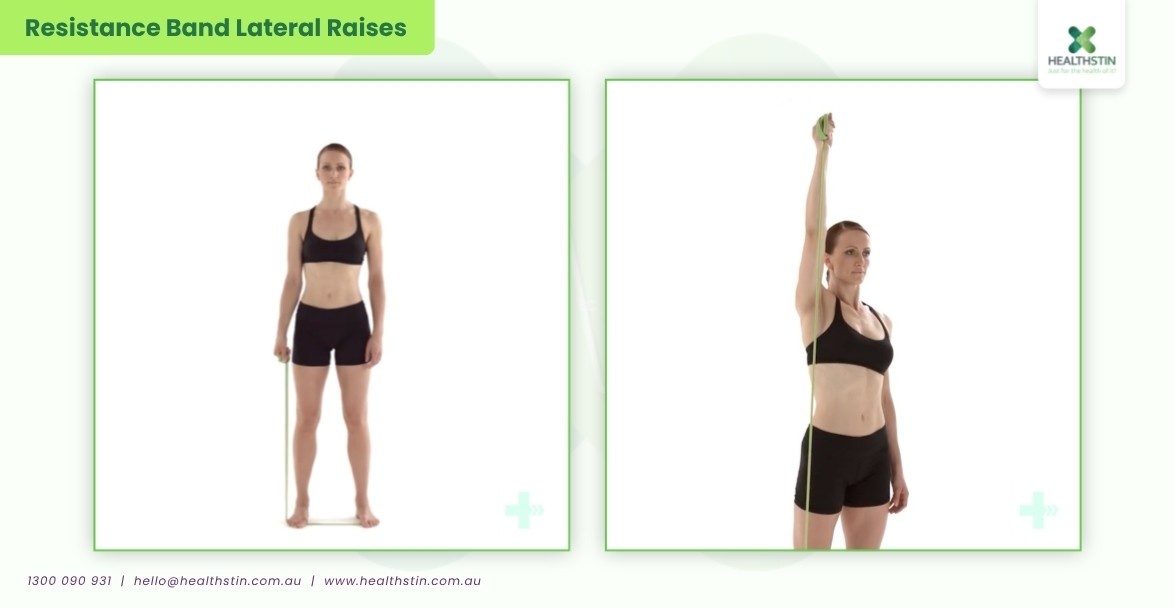
Instructions:
- Stand upright with your feet placed firmly on a resistance band to secure it.
- Hold the other end of the band in your affected hand.
- Stand tall, relax your shoulders, and keep your neck long.
- Point your thumb up and keep your arm straight as you slowly lift it out to the side at a diagonal angle.
- Lift your arm until it is about level with your ear, working against the band’s resistance.
- Pause briefly at the top of the movement.
- Lower your arm slowly and with control back to the starting position.
- Repeat as directed.
Helpful Tip:
Try not to shrug your shoulder as you lift. Keep your shoulder blades steady and focus on moving smoothly and with control.
7. Band Pull-Aparts
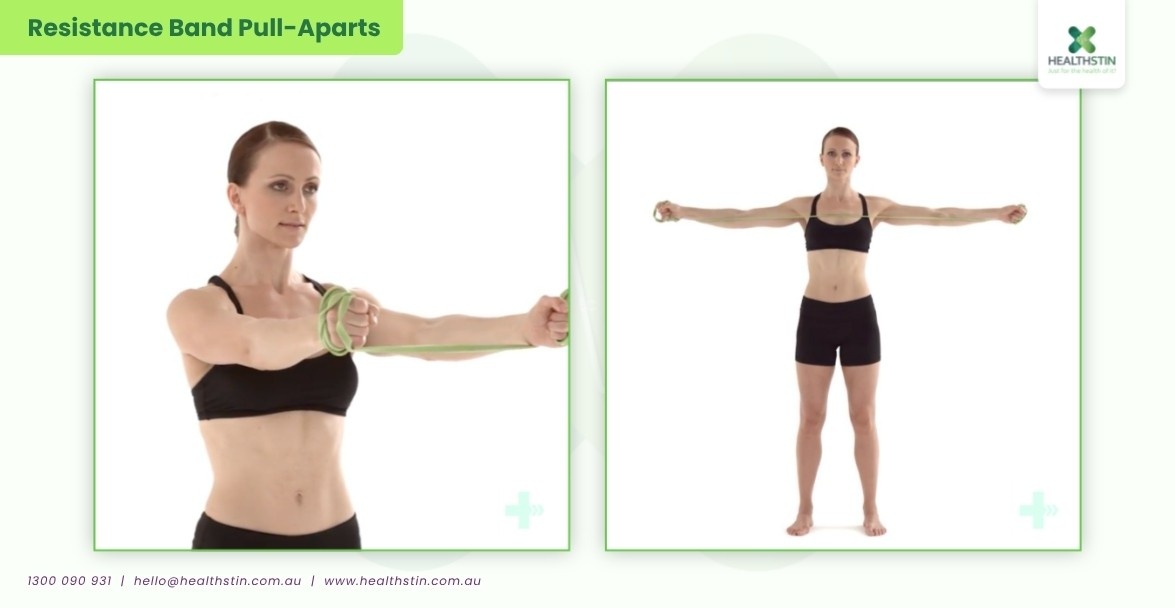
Band pull-aparts are an easy way to improve your posture by working your upper back and shoulder muscles. When you pull a resistance band apart in front of you, you activate muscles that can get weak from sitting for long periods.
You can easily add this exercise to your home routine. Over time, it can help your shoulders line up better and improve your upper body balance.
Instructions:
- Stand upright with your feet hip-width apart.
- Hold a resistance band with both hands at chest height.
- Keep your arms straight and create light tension in the band.
- Slowly pull your arms out to the sides until they form a “T” shape.
- As you open your arms, gently squeeze your shoulder blades together.
- Keep your shoulders relaxed and try not to shrug.
- Pause for a moment with your arms open.
- Slowly bring your arms back in front of your chest, keeping the movement controlled.
- Repeat the exercise as many times as recommended.
Helpful Tip:
Try to use your upper back muscles instead of relying on your arms. Move slowly and with control to keep tension on the band the whole time.
How to Structure a Resistance Band Workout
Having a plan helps you get more out of your resistance band workouts and keeps you safe. Here are some tips to organise your sessions for better results:
- Sets and reps: If you’re just starting out, try doing 2 sets of 12 repetitions. As you get stronger, you can add more sets or reps.
- Frequency: Aim to work out with resistance bands 2 to 4 times a week, depending on your fitness level and what you want to achieve.
- Rest periods: Take a break for 30 to 90 seconds between exercises. This helps you avoid getting too tired and lets you keep good form.
- Progression: To keep making progress, you can use a thicker band, do more repetitions, or slow down your movements as you get stronger.
Easy Adjustments for Beginners and Advanced Users
You can change resistance band routines to match your fitness level. Adjusting your routine helps you build strength safely and keep making progress, no matter how much experience you have.
| Modification | Beginner Approach | Advanced Approach |
| Band Resistance | Choose a lighter resistance band so you can focus on good form and control. | Pick a heavier band to make the exercise more challenging for your muscles. |
| Repetitions | Begin with 10 to 12 repetitions for each exercise. | Try doing 15 to 20 repetitions, or add more sets if you want a bigger challenge. |
| Tempo Control | Move at a pace that feels comfortable for you. | Slow your movements to make your muscles work harder and improve your control. |
Simple Mistakes That Can Affect Your Results
Bad Posture
Good posture during resistance band exercises helps you avoid straining your neck, shoulders, and back. Keep your chest up, relax your shoulders, and tighten your core as you move.
Using Incorrect Resistance
Picking the right resistance band helps you maintain good form whilst still challenging your muscles. If you are not sure, start with a lighter band and move up as you get stronger.
Rushing Movements
Resistance band exercises are most effective when you move with control. Slowing down can help your muscles work harder and make your workouts more effective.
Lack of Consistency
Building strength takes time. If you stick with your workouts, you will see improvements in your strength, mobility, and how you move every day.
Are Resistance Bands Effective for Strength and Weight Loss?
Yes, resistance bands work well for building strength and helping with weight loss if you use them regularly and with good technique. They make your muscles work harder with each movement, which helps you get stronger and fitter.
For the best results, mix resistance-band upper-body exercises with whole-body workouts and stay active all week. This helps you burn more calories, lose fat, and build muscle over time.
How Healthstin Can Help You Train Safely and Effectively
At Healthstin, we help people build strength safely and with a plan that fits their needs. Everyone moves differently and has unique goals, so the right support can really help when you start resistance-band upper-body exercises.
- Personalised programmes – We create exercise plans that match your fitness level, goals, and any health concerns you may have.
- Injury prevention – We teach you the right technique to help reduce strain and prevent setbacks.
- Rehabilitation support – We offer safe, low impact exercises to support your recovery and help you move better.
- Ongoing progress assessment – We check in regularly to help you stay on track and adjust your programme when necessary.
FAQs About Resistance Band Upper Body Exercises
1. Are resistance bands good for beginners?
Yes, resistance bands are great for beginners. They are easy to use, gentle on your joints, and you can adjust them to match your strength.
2. Can they replace weights?
Resistance bands can replace weights for many upper-body exercises, especially in home workouts, but some people still like to use both for variety.
3. How often should I train?
Most people get good results by training two or three times a week. Be sure to take rest days in between so your muscles can recover.
4. What resistance level should I use?
Pick a band that feels tough but still lets you keep good form and control during the whole exercise.
5. Are they safe for injury recovery?
Yes, if you use them the right way. Resistance bands are common in rehab because they let you move safely and gently.
Build Strength with a Plan That Works
It’s easier to get stronger when you have a clear plan that fits your body and your goals. With appropriate guidance, you can train safely, move better and stick to your routine, without having to guess what to do next.
At Healthstin, we offer personalised exercise physiology services to help with strength training, mobility, and rehabilitation. Our team supports beginners, older adults, and anyone recovering from injury so you can move and feel better.
If you need help with resistance-band upper-body exercises or want a programme made just for you, we’re here to support you.
Contact us to talk with our exercise team, or book your consultation using our form today.
*Disclaimer: The exercises and information in this article are meant as general guidance only and do not replace advice from a qualified healthcare professional. Weight loss programmes should always be personalised. Before starting any new exercises, talk to a physiotherapist, exercise physiologist, or your healthcare provider to make sure they are safe and right for you.